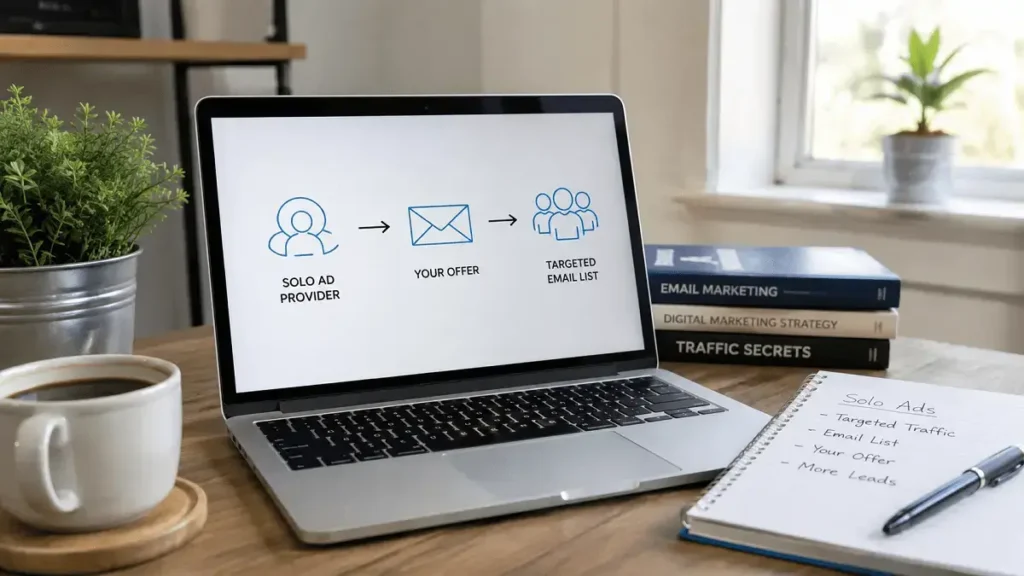
Solo ads work by paying someone with an email audience to send visitors to your page.
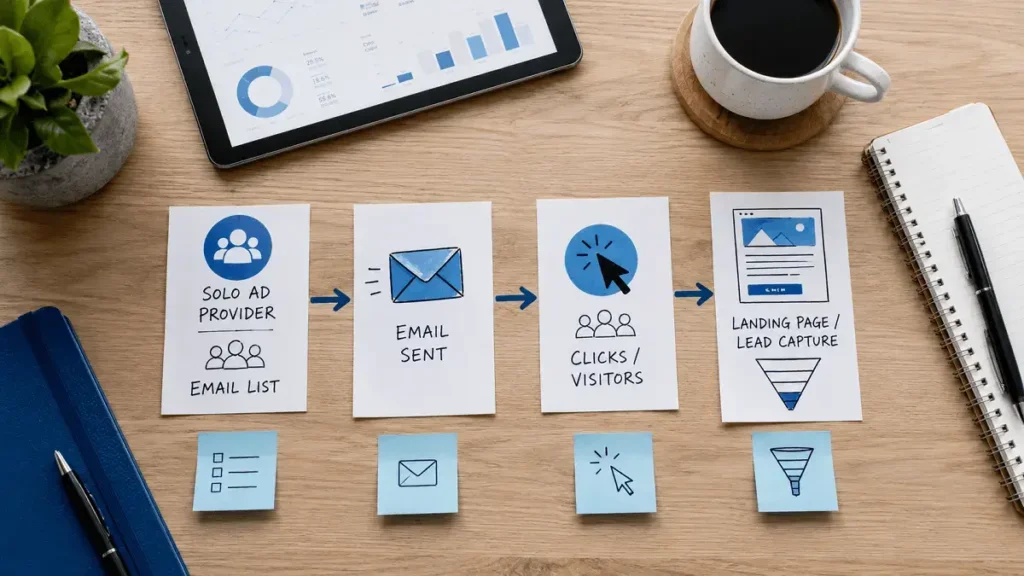
You normally choose how many clicks you want, give the provider your link, and wait for the traffic to arrive. The provider sends an email to their audience, people click the link, and those visitors land on your page.
Simple flow
Choose a provider → buy clicks → prepare your page → provider sends the email → visitors arrive → you track the results
That part is straightforward.
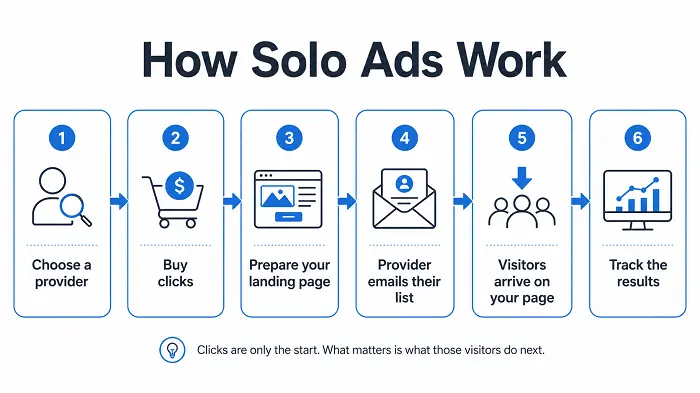
Where people usually get caught out is assuming that a completed order means a successful campaign. Getting 300 clicks is one thing. Getting 300 clicks that turn into useful subscribers is another.
- A Quick Example
- First, You Need Somewhere to Buy the Traffic
- How Many Clicks Do You Buy?
- Targeting Comes Next
- Your Landing Page Should Be Ready Before You Order
- Set Up Tracking Before the Campaign Starts
- Then You Give the Provider Your Link
- The Provider Sends the Email
- What Happens While the Traffic Is Being Delivered?
- What Happens When All the Clicks Have Been Delivered?
- Why Your Click Count May Not Match the Provider's Exactly
- Things That Can Go Wrong
- A High Opt-In Rate Can Fool You
- Decide What a Good Campaign Means Before You Buy
- How Do You Decide Whether to Buy Again?
A Quick Example
Say you order 200 clicks for $160.
Example
Cost: $160
Clicks delivered: 200
New subscribers: 68
Opt-in rate: 34%
Cost per lead: about $2.35
Now you have something useful to work with.
But I still wouldn’t judge the campaign from those numbers alone.
If most of those 68 subscribers never open or click another email, the campaign may not be as good as the opt-in rate first suggested.
That is why I think of solo ads as a process rather than a one-time traffic purchase.
First, You Need Somewhere to Buy the Traffic
Solo ads can be bought in a few different ways.
You might buy directly from an individual seller, use a traffic company, or use a marketplace where several sellers are listed in one place.
A marketplace can make comparison easier because you can usually see more information about individual sellers before ordering.
Buying direct can be simpler, but the amount of information available depends on the provider.
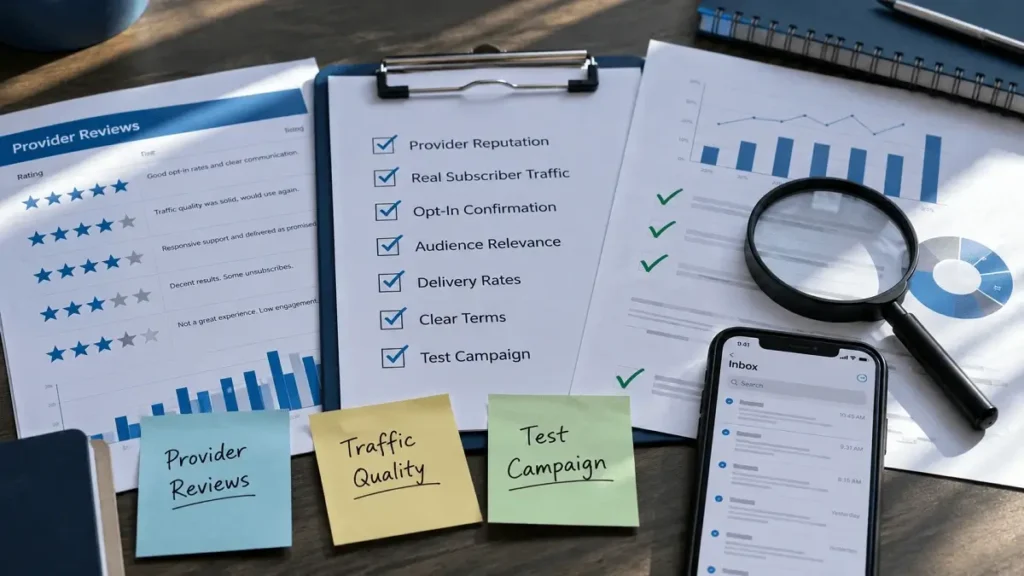
Before spending anything, I would look at:
- price per click
- minimum order
- available countries
- targeting options
- delivery terms
- refund or replacement policy
- buyer feedback
- how clearly the provider explains the traffic
You do not need to know everything about a provider before testing them, but I would want more than a checkout button and a promise of “high-quality traffic.”
See How to Choose a Solo Ad Provider for a deeper look at this.
How Many Clicks Do You Buy?
Once you have a provider, you choose an order size.
You may see options such as:
- 100 clicks
- 200 clicks
- 300 clicks
- 500 clicks
- 1,000 clicks
The temptation is to think that more clicks automatically means a better test.
Not always.
If you know very little about a provider, a smaller order can tell you quite a lot without putting a large budget at risk.
Example
Price per click: $0.70
Test size: 200 clicks
Estimated cost: $140
If that test produces promising leads, you can decide whether another order makes sense.
If it does not, you have learned something without spending $700 on 1,000 clicks.
I cover test sizes separately in How Many Solo Ad Clicks Should You Buy?
Targeting Comes Next
Some providers let you choose who you want the traffic to come from.
That might include things like:
- country
- Tier 1 countries
- niche
- device
- gender
- buyer-related audiences
The options vary a lot from one provider to another.
I would not pay for targeting just because more filters sound better.
The useful question is whether the targeting helps you reach people who are more likely to care about your page or offer.
If your funnel is designed for US visitors, for example, then paying extra for the right geography can make sense.
Your Landing Page Should Be Ready Before You Order
I would never place the order first and start fixing the landing page afterward.
Once traffic starts arriving, every broken form, slow page, or bad mobile layout costs you real clicks.
Before sending traffic, check:
- the page loads quickly
- it works on mobile
- the form submits properly
- subscribers go to the correct email list
- the thank-you page works
- your follow-up emails are active
A solo ad landing page is usually fairly simple.
It normally has one main job: convince the visitor to take the next step.
Too many links, menus, buttons, and unrelated information can work against that.
Set Up Tracking Before the Campaign Starts
Tracking is one of those things that seems unnecessary until you need it.
At minimum, I would want to know:
- how many clicks arrived
- where they came from
- how many people opted in
- how much each lead cost
If you plan to test more than one provider, make sure you can separate the campaigns.
You can do that with:
- separate tracking links
- UTM parameters
- different landing-page URLs
- tracking software
- tags inside your email platform
The exact method is less important than being able to answer one simple question later:
Which provider sent these leads?
If all your traffic is mixed together, comparing sellers becomes difficult very quickly.
Then You Give the Provider Your Link
Once the page and tracking are ready, you send the provider the URL.
That may be your landing-page URL directly, or it may be a tracking link that redirects the visitor to your page.
If you are using a tracker, the path might look like this:
Tracked traffic
Provider email → Tracking link → Landing page
The tracking step lets you record information about the visit before sending the person to the final page.
The Provider Sends the Email
The provider then sends an email to part of their audience.
Your link appears somewhere in that email.
People who are interested click it and arrive on your page.
You normally do not receive the provider’s email database. They send the email themselves.
That is one of the main differences between buying a solo ad and buying a list of email addresses.
What Happens While the Traffic Is Being Delivered?
Delivery can take different amounts of time.
Some orders may finish quickly. Others may be spread out over a longer period.
I would keep an eye on the campaign, but I would not sit refreshing the dashboard every few minutes.
A few things are worth checking:
Is the traffic actually arriving?
Your own analytics should show activity.
Does the geography look right?
If you paid for certain countries, check whether your data roughly matches.
Is the landing page still working?
Forms break. Plugins fail. Pages occasionally go down.
Are people opting in?
A very low opt-in rate can be a sign that something needs attention.
Is your tracking recording properly?
Finding out after delivery that your tracking link was broken is not much fun.
What Happens When All the Clicks Have Been Delivered?
This is where I would avoid making a quick decision.
The provider may have done their part once the agreed number of clicks has arrived.
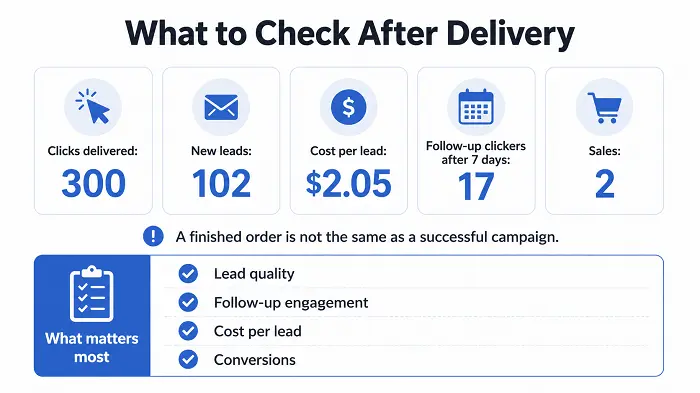
Your campaign still has more to tell you.
After delivery
Clicks: 300
New leads: 102
Cost per lead: $2.05
Follow-up clickers after 7 days: 17
Sales: 2
The first two numbers tell you what happened on the landing page.
The later numbers tell you more about whether those subscribers were actually interested.
That difference matters.
Why Your Click Count May Not Match the Provider’s Exactly
Your tracker and the provider’s system may show slightly different numbers.
That does not automatically mean anything is wrong.
Different systems may handle things such as:
- duplicate clicks
- repeat visitors
- bots
- suspicious activity
- excluded countries
in different ways.
A small difference is one thing.
If your tracker shows 170 visitors and the provider says 300 valid clicks were delivered, I would want an explanation.
It helps to understand how the provider counts a valid click before buying.
Things That Can Go Wrong
Solo ads are fairly simple, but there are still several ways a campaign can go sideways.
The page is broken
Paid traffic reaches a form that does not work.
Tracking is wrong
You receive visitors but cannot tell where they came from.
The audience is a poor fit
The traffic may be real while still being wrong for your offer.
The opt-in rate is weak
That could point to the traffic, the page, or both.
The opt-in rate is great, but nobody engages later
This one is easy to miss because the campaign initially looks good.
The traffic arrives in a strange pattern
Fast delivery is not automatically bad, but unusually concentrated traffic is worth checking more closely.
The geography is different from what you ordered
If geography was part of the deal, compare it with your own analytics.
A High Opt-In Rate Can Fool You
Imagine two campaigns.
Campaign A
Clicks: 200
Opt-ins: 90
Opt-in rate: 45%
Follow-up clickers: 5Campaign B
Clicks: 200
Opt-ins: 62
Opt-in rate: 31%
Follow-up clickers: 21
If you only look at the landing page, Campaign A wins easily.
If you care about building an engaged list, Campaign B suddenly looks much more interesting.
That does not make opt-in rate useless. It just means it should not be the only number you care about.
This is one of the things I think gets overlooked most often with solo ads.
Decide What a Good Campaign Means Before You Buy
It is much easier to judge a campaign when you know what you are looking for.
If your main goal is list building, you may care about:
- cost per lead
- opt-in rate
- follow-up engagement
If your main goal is sales, you may care more about:
- conversions
- revenue
- return on ad spend
- break-even point
I would write down the basic target before placing the order.
Before the campaign
Budget: $200
Planned clicks: 250
Main goal: build the email list
Maximum CPL I am comfortable with: $3
Check lead engagement again: 7 days after delivery
The exact numbers are only an example.
What matters is having something to compare the result against.
Otherwise, it is very easy to look at almost any campaign afterward and find a reason to call it successful.
How Do You Decide Whether to Buy Again?
I would look at the whole experience.
Ask yourself:
- Did the provider deliver what was ordered?
- Did the geography look reasonable?
- Was the cost per lead acceptable?
- Did the subscribers engage afterward?
- Did anything in the traffic look unusual?
- Was communication with the provider good?
- Did the campaign fit your offer?
A seller delivering all 300 clicks quickly is not enough reason by itself to place another order.
Likewise, one average test does not automatically mean the provider is terrible.
Traffic can vary, funnels can vary, and experiences can vary.
The goal is to make the next decision with more information than you had before the first order.
Solo ads themselves are not complicated. You buy traffic, the provider emails their audience, and the visitors arrive on your page.
What takes more work is measuring whether those visitors were actually useful.
If you’re new to solo ads, the next thing worth understanding is Are Solo Ads Legit?