

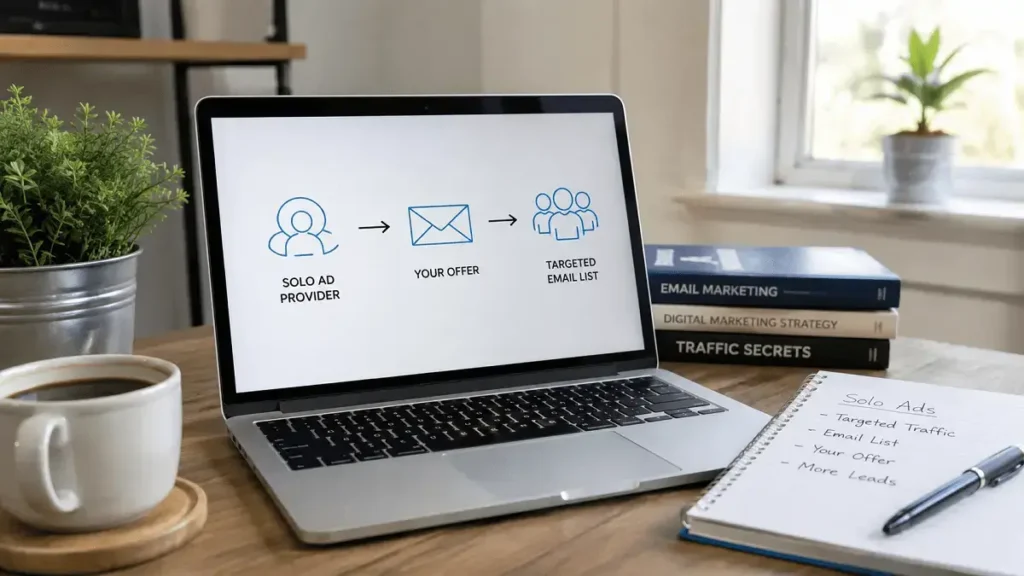
If you have seen people talking about buying clicks from an email list, they are probably talking about solo ads.
The idea is straightforward: somebody already has an email audience, you pay them to promote your link to that audience, and interested readers click through to your page.
Quick Answer
Solo ads are paid email traffic. You pay a provider with an existing email audience to send a set number of visitors to your landing page.
You are buying clicks, not guaranteed leads or sales. What happens after the click depends on the audience, your page, your offer and your follow-up.
- What Is a Solo Ad?
- A Simple Solo Ad Example
- What Are You Actually Buying?
- Where Do Solo Ad Clicks Come From?
- What Does the Email Look Like?
- Where Do You Send the Traffic?
- How Much Do Solo Ads Cost?
- What Is Tier 1 Traffic?
- Are Solo Ads Legit?
- Are Solo Ads Worth It?
- How Many Clicks Should a Beginner Buy?
- Solo Ads in One Sentence
- Frequently Asked Questions
What Is a Solo Ad?
A solo ad is an email promotion sent to another person’s subscriber list. Instead of building that audience yourself first, you pay the list owner or traffic provider for access to it.
The basic flow is simple: choose a provider → buy clicks → give them your link → they send the email → visitors arrive on your page.
For the full process, see How Do Solo Ads Work?. If your next question is where to get the traffic, see Where to Buy Solo Ads. For affiliate funnels specifically, read Solo Ads for Affiliate Marketing.
A Simple Solo Ad Example
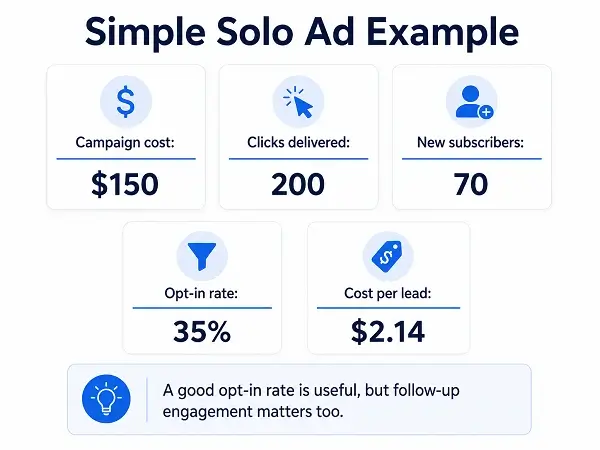
Imagine you have a landing page offering a free guide and you buy 200 clicks at $0.60 each. The traffic costs $120.
The provider emails their audience, interested subscribers click, and once 200 visitors have reached your page the traffic order is normally considered delivered.
What happens next is where your own funnel matters. Some visitors may leave, some may join your list, and a smaller number may click your follow-up emails or eventually buy something.
The seller is mainly providing the traffic. They are not selling 200 guaranteed customers.
What Are You Actually Buying?
Most solo ads are sold as a fixed number of clicks: 100, 250, 500, 1,000 or another amount agreed with the provider. You may also be able to choose countries or other targeting options.
Buying 500 clicks does not mean you are buying 500 subscribers or buyers. You are paying for people to visit your page, and the conversion depends on what happens after they arrive.
Where Do Solo Ad Clicks Come From?
Solo ad providers generally have access to email audiences in a particular market. Some own and manage their own lists, while others may work with several traffic sources.
That is one reason results can vary so much from one seller to another. If you are deciding who to buy from, see How to Choose a Solo Ad Provider.
What Does the Email Look Like?
The email is usually simple. It gives the reader a reason to click and sends interested subscribers to your link. The wording varies by provider and offer, but the key point is that the provider sends the email to their audience on your behalf.
Where Do You Send the Traffic?
Usually to a focused landing page. A common setup is solo ad email → landing page → email opt-in → follow-up emails.
You can send traffic directly to a sales page, but many buyers prefer collecting an email address first because that gives them a chance to continue the conversation after the paid click is over.
How Much Do Solo Ads Cost?
Solo ads are commonly sold on a cost-per-click basis. If the seller charges $0.60 per click, 250 clicks cost $150. If the price is $0.70, 500 clicks cost $350.
Actual prices vary by provider, audience and targeting. The cheapest click is not automatically the best value. See How Much Do Solo Ads Cost? for a fuller breakdown.
What Is Tier 1 Traffic?
You may see sellers advertising Tier 1 traffic. This usually means visitors from major English-speaking markets such as the United States, United Kingdom, Canada and Australia, although definitions can vary.
Check which countries the seller actually includes before ordering. We explain this in What Is Tier 1 Solo Ad Traffic?.
Are Solo Ads Legit?
Yes, solo ads are a real paid traffic model. What varies is the quality of the provider and audience. Real traffic can still be poorly matched, overused or simply not suitable for your offer.
If that is your main concern, read Are Solo Ads Legit?.
Are Solo Ads Worth It?
Sometimes. They make more sense when you have a clear landing page, an offer that fits the audience, a reasonable testing budget and a way to follow up with leads.
They make much less sense if you expect to buy traffic once and automatically make money. Whether the numbers work depends on what those clicks actually produce. See Are Solo Ads Worth It?.
How Many Clicks Should a Beginner Buy?
You do not need thousands of clicks for your first test. Starting smaller lets you see how the traffic behaves before committing much more money.
The right size depends on your budget and what you are trying to learn. See How Many Solo Ad Clicks Should You Buy?.
Solo Ads in One Sentence
A solo ad is a way to rent access to someone else’s email audience and pay for the visitors they send to your page.
You are buying an opportunity to put your page in front of that audience. You are not buying a guaranteed result.