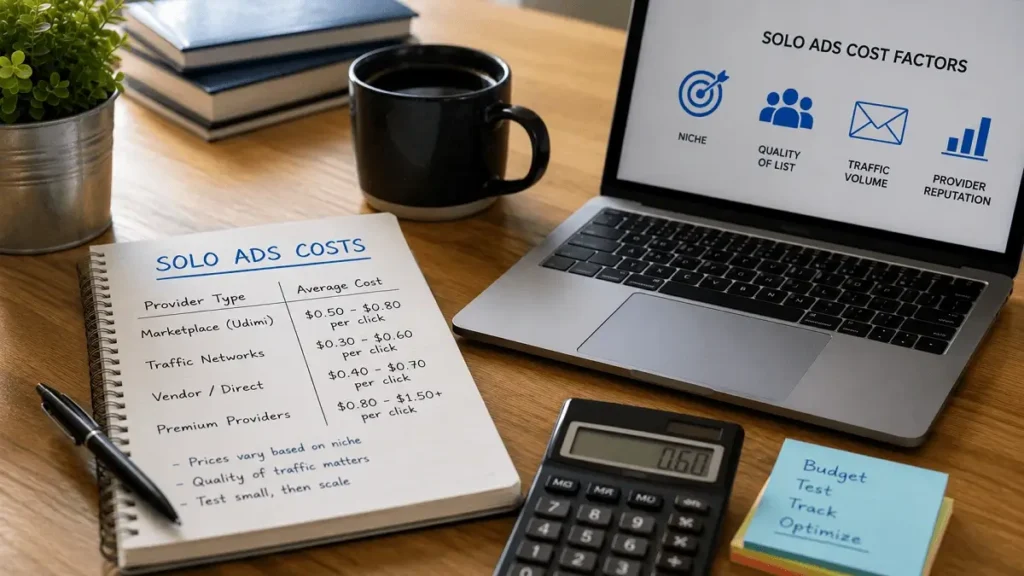
Solo ads are usually priced by the click, so the basic cost depends on two things: how much the provider charges per click and how many clicks you buy.
There is no single standard price.
In a current spot-check, I found Udimi sellers advertising traffic from around $0.40 per click to more than $1 per click, while one direct provider was offering larger packages for around $0.23–$0.28 per click. Those are examples rather than a universal market rate, and prices can change at any time.
Simple example
Price per click: $0.60
Clicks ordered: 200200 × $0.60 = $120 campaign cost
That calculation is easy.
The more useful question is what those $120 worth of clicks actually produce.
- What Can 100, 250 or 500 Solo Ad Clicks Cost?
- Why Do Solo Ad Prices Vary So Much?
- Price per Click Is Only the Starting Number
- How to Calculate Cost per Lead
- Even Cost per Lead Doesn't Tell the Whole Story
- What Does a Small Solo Ad Test Cost?
- How Much Would I Budget for a First Test?
- Don't Let Volume Discounts Push You Into a Bad Test
- There Can Be Costs Beyond the Traffic
- What About Over-Delivery?
- Is More Expensive Solo Ad Traffic Better?
- The Number I Would Watch Before Scaling
- Day-One Cost Can Be Misleading Too
- How I Would Compare Two Solo Ad Prices
- So What Should You Expect to Spend?
What Can 100, 250 or 500 Solo Ad Clicks Cost?
Using $0.60 per click as a simple example:
100 clicks
100 × $0.60 = $60
250 clicks
250 × $0.60 = $150
500 clicks
500 × $0.60 = $300
1,000 clicks
1,000 × $0.60 = $600
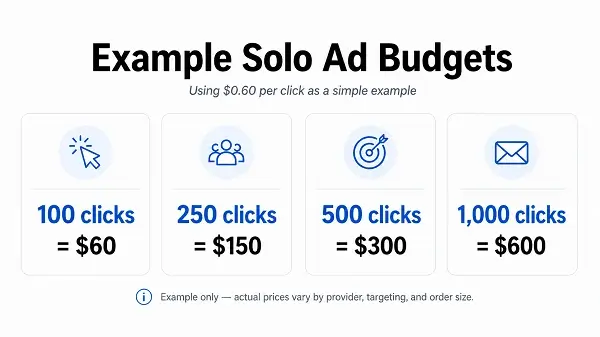
Your actual price could be lower or considerably higher depending on the seller, targeting and type of traffic.
Some providers also reduce the cost per click on larger packages.
For example, 7DaysBuyer currently lists 100 clicks at $28 and 1,000 clicks at $230, bringing the advertised price down from $0.28 to $0.23 per click as the order gets larger.
That discount can look attractive, but I would not buy a large first order just to save a few cents per click.
Learning whether the traffic is any good is more important.
Why Do Solo Ad Prices Vary So Much?
Two providers can sell the same number of clicks at very different prices.
There are several reasons for that.
Traffic geography
Traffic from countries such as the United States, Canada, United Kingdom or Australia may cost more than broader worldwide traffic.
Seller reputation
Providers with a long history, large numbers of reviews or strong demand may charge more.
Audience
A seller who claims to have a more active buyer-oriented list may price their traffic differently from someone offering broad general traffic.
That does not automatically mean the more expensive list is better.
Targeting
Country, niche, device or other targeting can affect pricing.
Marketplace costs
Buying through a marketplace can include services such as filtering, tracking or buyer protection that may not exist when dealing with a seller directly.
Order size
Some providers lower the price per click when you buy more traffic.
Price per Click Is Only the Starting Number
This is the part I would pay more attention to.
Imagine Provider A charges $0.40 per click and Provider B charges $0.70.
Provider A looks much cheaper.
Now look at what happens after the traffic arrives.
Provider A
Campaign cost: $120
Clicks: 300
Leads: 30
Cost per lead: $4
Provider B
Campaign cost: $210
Clicks: 300
Leads: 105
Cost per lead: $2
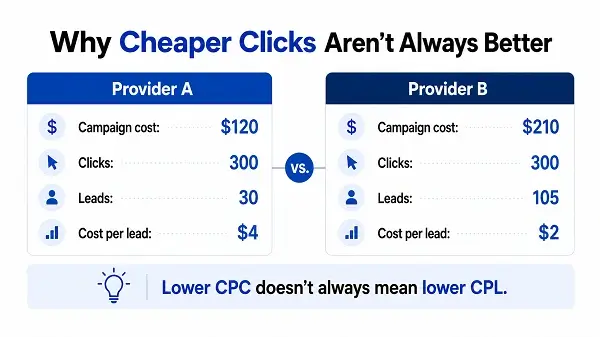
Provider B charged much more for the traffic.
But the leads ended up costing half as much.
That is why I would not choose a solo ad seller based on CPC alone.
How to Calculate Cost per Lead
The formula is simple:
Cost per lead = Campaign cost ÷ Number of leads
Suppose you spend $180 and generate 90 subscribers.
$180 ÷ 90 = $2 per lead
Now you have a number that is easier to compare between campaigns.
You can test one provider against another and ask:
How much did each actual subscriber cost me?
That is usually more useful than simply asking who sold the cheapest clicks.
Even Cost per Lead Doesn’t Tell the Whole Story
Here is where it gets more interesting.
Two campaigns can produce leads at exactly the same price and still have very different value.
Campaign A
100 leads
CPL: $2
Follow-up clickers after 14 days: 7
Campaign B
100 leads
CPL: $2
Follow-up clickers after 14 days: 26
Both campaigns cost the same per lead.
But Campaign B appears to have produced a much more engaged audience.
This is one reason I want Solo Ads Experts to look at what happens after the opt-in, not just the original campaign numbers.
Cheap leads that never engage may turn out to be expensive traffic.
What Does a Small Solo Ad Test Cost?
For someone testing a new provider, I would usually think in terms of a manageable test rather than the biggest package available.
Using example prices:
At $0.40 per click
100 clicks = $40
200 clicks = $80
300 clicks = $120
At $0.70 per click
100 clicks = $70
200 clicks = $140
300 clicks = $210
At $1.00 per click
100 clicks = $100
200 clicks = $200
300 clicks = $300
A small test does not guarantee that you will learn everything about a provider.
It simply limits how much money you put at risk while getting your first real data.
How Much Would I Budget for a First Test?
There is no number that works for everyone.
I would start by deciding how much I am comfortable spending even if the campaign produces nothing useful.
That is your test budget.
If losing $200 would be a serious problem, I would not spend $200 just because a provider recommends that order size.
You can then work backward.
Example
Test budget: $150
Provider price: $0.60 per click$150 ÷ $0.60 = 250 clicks
Now you know roughly how much traffic your budget buys.
Don’t Let Volume Discounts Push You Into a Bad Test
This is something worth watching.
Imagine a provider offers:
200 clicks: $0.65 each
500 clicks: $0.55 each
1,000 clicks: $0.45 each
The 1,000-click package looks like much better value.
But:
200 clicks × $0.65 = $130
1,000 clicks × $0.45 = $450
You are saving $0.20 per click, but you are risking another $320 with a provider you may never have used before.
If the traffic turns out to be poor, the discounted clicks were not much of a bargain.
There Can Be Costs Beyond the Traffic
The solo ad order itself may not be your only expense.
Depending on your setup, you may also pay for:
- landing page software
- email marketing software
- tracking software
- domain or hosting
- copy or design work
- marketplace upgrades or optional filters
You do not need expensive software for every campaign, but those costs still matter when calculating whether the overall system makes sense.
For example:
Campaign
Traffic: $200
Tracking tool allocation: $20
Landing page/software allocation: $15Total campaign-related cost: $235
If you calculate ROI using only the $200 traffic purchase, you are ignoring part of what the campaign actually cost.
What About Over-Delivery?
Some providers deliver more clicks than you purchased.
For example:
Clicks ordered: 500
Bonus over-delivery: 10%
Total clicks received: 550
That lowers your effective cost per delivered click.
If the 500-click package cost $300:
$300 ÷ 550 = about $0.55 per delivered click
rather than $0.60.
Over-delivery is nice to have, but I would not choose a provider based on bonus clicks alone.
Five hundred useful clicks are worth more than six hundred poor ones.
Is More Expensive Solo Ad Traffic Better?
Not necessarily.
A higher price can reflect:
- stronger demand
- better targeting
- seller reputation
- marketplace positioning
- a supposedly higher-quality audience
But price alone does not prove quality.
Likewise, a low price does not prove the traffic is bad.
The only way to know how useful a provider is for your funnel is to measure what their traffic actually does.
The Number I Would Watch Before Scaling
Before increasing an order, I would want to know roughly how much I can afford to pay for a lead.
Suppose your average subscriber eventually generates about $4 in revenue.
Average lead value: $4
Cost per lead: $2.25Difference before other costs: $1.75 per lead
That leaves some room.
If your leads are worth $2 but cost $4 each, scaling the exact same campaign probably does not make much sense.
This is why knowing lead value eventually becomes more important than knowing the cost per click.
Day-One Cost Can Be Misleading Too
Solo ads are often used to build an email list.
Some subscribers may buy immediately.
Others may buy after several emails.
So I would look at campaign economics at more than one point.
Day 0
Campaign cost
Clicks
Opt-ins
CPL
Day 7
Follow-up engagement
Email clicks
Early conversions
Day 30
Total conversions
Total revenue
Longer-term engagement
That does not mean waiting forever and hoping a bad campaign magically becomes profitable.
It simply gives an email campaign enough time to show whether the leads have any value beyond the initial signup.
How I Would Compare Two Solo Ad Prices
If I were choosing between two providers, I would not compare only:
Provider A: $0.45 per click
Provider B: $0.70 per click
I would eventually want a comparison closer to this:
Provider A
CPC: $0.45
CPL: $3.20
7-day engagement: weak
Provider B
CPC: $0.70
CPL: $2.40
7-day engagement: stronger
Now the extra $0.25 per click has some context.
The cheaper traffic may actually be costing more.
So What Should You Expect to Spend?
A small solo ad test can cost anywhere from tens of dollars to several hundred dollars depending on the provider and number of clicks you choose.
Current listings show just how wide the range can be. Some Udimi sellers I checked were around $0.40 per click, while others were roughly $0.80–$1.05. A direct provider I checked advertised larger packages below $0.30 per click.
I would treat those numbers as a snapshot, not a rule.
What matters more is what you get for the money.
A $0.40 click that produces a $4 lead is more expensive than a $0.80 click that produces a $2 lead.
And even the $2 lead is only attractive if those subscribers actually do something afterward.
That is the number trail I would follow:
Traffic cost → Cost per click → Cost per lead → Engagement → Conversions → Lead value
Once you start thinking about solo ad pricing that way, the cheapest provider stops automatically looking like the best deal.
Next guide: How to Choose a Solo Ad Provider