

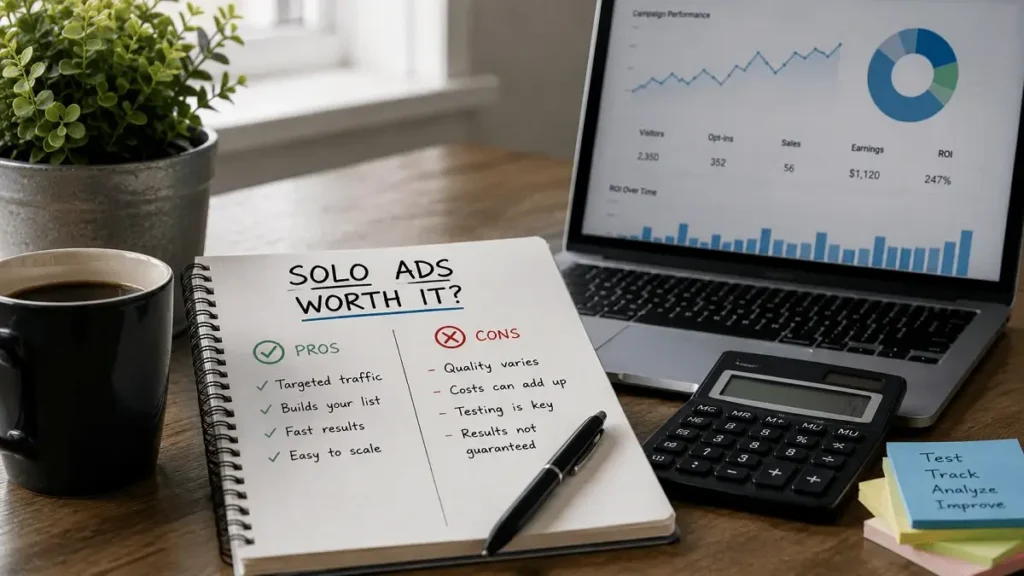
Solo ads can be worth it, but I would not buy them just because somebody promises cheap clicks.
They make much more sense when you already have a focused landing page, an email follow-up sequence and a clear reason for buying the traffic. If those pieces are not ready, buying more clicks usually only exposes the weak parts of the funnel faster.
Quick Answer
Solo ads can be worth it when you already have a focused landing page, email follow-up and a clear way to measure what happens after the click. I would treat the first order as a test, not as guaranteed profit.
The real question is not whether the provider delivered the clicks. It is whether those clicks produced leads, engagement or sales at a cost your funnel can support.
- A Simple Way to Decide Whether Solo Ads Are Worth It
- What Does “Worth It” Mean for Your Goal?
- When Solo Ads Make Sense
- When I Would Be More Cautious
- The Main Advantage and the Main Risk
- Solo Ads vs Other Traffic Sources
- Don't Confuse “Legit” With “Worth It”
- Are Solo Ads Worth It for Affiliate Marketing?
- How Much Should You Spend on the First Test?
- How I Would Decide Whether to Buy Again
- Don't Judge a List-Building Campaign Too Early
- So, Are Solo Ads Worth It?
- Frequently Asked Questions
A Simple Way to Decide Whether Solo Ads Are Worth It
Start with the economics. Say you buy 200 clicks at $0.70 each, so the traffic costs $140. If your landing page converts 35% of visitors, you get 70 leads and your cost per lead is $2.
| Metric | Result |
|---|---|
| Clicks | 200 |
| Traffic cost | $140 |
| Opt-in rate | 35% |
| Leads | 70 |
| Cost per lead | $2.00 |
Those numbers are useful, but they are not enough to answer the question. If the 70 subscribers never open another email, click an offer or buy anything, the campaign may still be poor. A second campaign with a slightly higher CPL can be more valuable if those subscribers continue engaging.
That is why I would judge solo ads by the full path from click → lead → engagement → conversion. If you want the detailed math, see How to Calculate Solo Ad ROI.
What Does “Worth It” Mean for Your Goal?
It depends on what you are buying the traffic for. If the goal is an immediate sale, the campaign eventually needs to return enough revenue to justify the cost. If the goal is list building, the value may show up later through follow-up clicks and sales.
This is where people often make the wrong comparison. A cheap CPC can look attractive, and a high opt-in rate can look impressive, but neither tells you whether the campaign created useful customers or subscribers.
For list building, I would watch cost per lead and what those leads do over the next few days or weeks. For direct-response campaigns, I would also watch conversions, revenue and ROI. Our Solo Ad ROI Calculator and Cost Per Lead Calculator make those comparisons easier.
When Solo Ads Make Sense
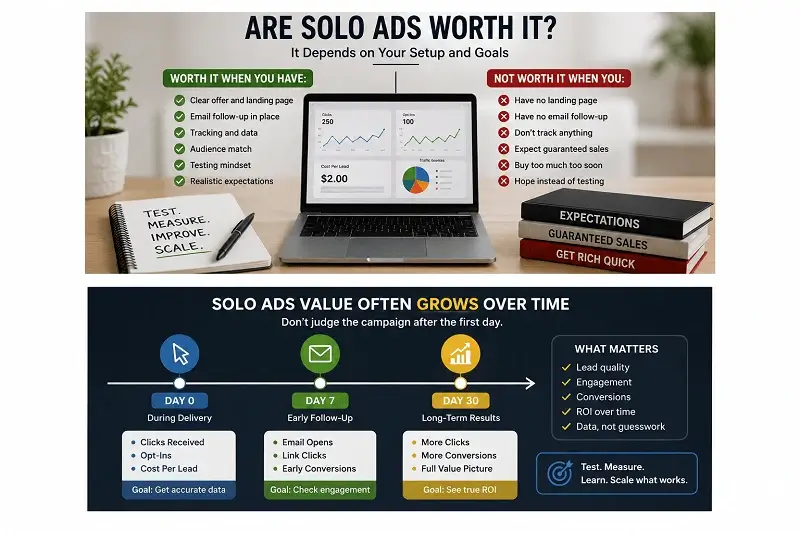
Solo ads are easier to justify when the rest of the funnel is already in place. I would want a focused landing page with one obvious action, a working email sequence and an offer that fits the audience.
- Your landing page is ready. The visitor should not arrive on a general homepage with ten unrelated choices.
- You have follow-up emails. A paid click is more useful when an opt-in gives you another chance to communicate.
- The offer fits the audience. Solo ad traffic is commonly associated with online business, affiliate marketing and email marketing, but not every offer fits every list.
- You can track the campaign. You should be able to separate one provider from another and see which traffic produced the leads.
- You can afford to test. A first campaign should give you information without putting your entire budget at risk.
For the tracking side, see How to Track Solo Ads.
When I Would Be More Cautious
I would be much less excited about solo ads if the plan is simply to buy traffic, send it straight to an offer and hope people buy. That gives you one chance to convert the visitor and almost no room for follow-up.
I would also avoid a test if losing the entire test budget would create a problem. Paid traffic is not guaranteed, and even legitimate traffic can perform badly when the page, offer or audience fit is weak.
Solo ads are useful as a controlled test. They are a poor rescue plan for a funnel that has not been tested at all.
The Main Advantage and the Main Risk
The biggest advantage is speed. You can put a real audience in front of a page without spending months building traffic first. That makes it possible to learn quickly whether people opt in, whether the follow-up gets clicks and whether one provider performs better than another.
The biggest risk is that you are borrowing somebody else’s audience. You do not control how the list was built, how often it receives promotions or how many similar offers those subscribers have already seen. Two providers can therefore sell what sounds like the same type of traffic and produce very different results.
That uncertainty is exactly why I prefer a smaller first order. You are buying traffic, but you are also buying information about whether that audience deserves a larger second test.
Solo Ads vs Other Traffic Sources
There is no universal winner. Search ads can reach people who are actively looking for something. Social ads can offer more detailed targeting. SEO can produce traffic without paying for every click, but it takes time to build.
Solo ads are different because you are paying for access to an existing email audience. They can be fast and simple to test, but the targeting is often less precise.
| Solo ads can make sense when… | I would be cautious when… |
|---|---|
| You already have a landing page | You are sending traffic to a general homepage |
| Your offer fits the audience | The offer is unrelated to the list |
| You have email follow-up ready | You have no follow-up |
| You can track the campaign | You cannot tell where leads came from |
| You can afford a test | You need guaranteed profit |
Don’t Confuse “Legit” With “Worth It”
These are separate questions. A provider can send real human traffic and the campaign can still lose money. That does not automatically mean the provider was a scam.
The audience may not fit the offer, the landing page may convert poorly, the follow-up may be weak or the traffic may simply cost more than those leads are worth.
If your concern is whether the traffic itself looks real or suspicious, read Are Solo Ads Legit?. This page is about the financial and strategic question: was the traffic valuable enough to justify buying again?
Are Solo Ads Worth It for Affiliate Marketing?
They can be, especially when the audience already has an interest in online business or marketing. I would still prefer sending the click to an opt-in page first rather than directly to an affiliate offer.
The flow is simple: solo ad → landing page → email signup → follow-up → affiliate offer. That gives one paid click more than one chance to create value.
For a full explanation, see Solo Ads for Affiliate Marketing.
How Much Should You Spend on the First Test?
I would not start with the biggest package just because it has a lower price per click. With a provider I have never used, roughly 100–300 clicks is often enough to get an initial read without committing a large budget.
You can then check whether the traffic arrived correctly, whether the geography looked reasonable, how many visitors became leads and whether those subscribers did anything afterward. If the signals are encouraging, another test is easier to justify.
For more detail, see How Many Solo Ad Clicks Should You Buy? and How Much Do Solo Ads Cost?.
How I Would Decide Whether to Buy Again
I would ask four questions: Did I receive what I ordered? Did enough visitors become leads? Did those leads show useful engagement? And does the campaign look capable of producing enough value to justify another test?
If the answer is mostly yes, I would test again. If the only argument is “maybe next time will be better,” I would stop and work out what failed before buying more traffic.
Don’t Judge a List-Building Campaign Too Early
A campaign can look weak on the day the traffic arrives and improve later. If you spend $200 and make only $80 immediately, that looks poor. But if the new subscribers continue clicking emails and more sales arrive over the next two weeks, the same campaign may look very different.
That does not mean you should wait forever. Give the campaign enough time to show whether the leads have any life, then make a decision from the data rather than from hope.
So, Are Solo Ads Worth It?
Yes, they can be worth testing when the funnel is ready and the traffic fits the offer. I like them much more as a measured traffic test than as a shortcut to guaranteed profit.
The first order does not need to prove that solo ads are good or bad forever. It needs to answer one smaller question: did this traffic create enough value to justify another test?