

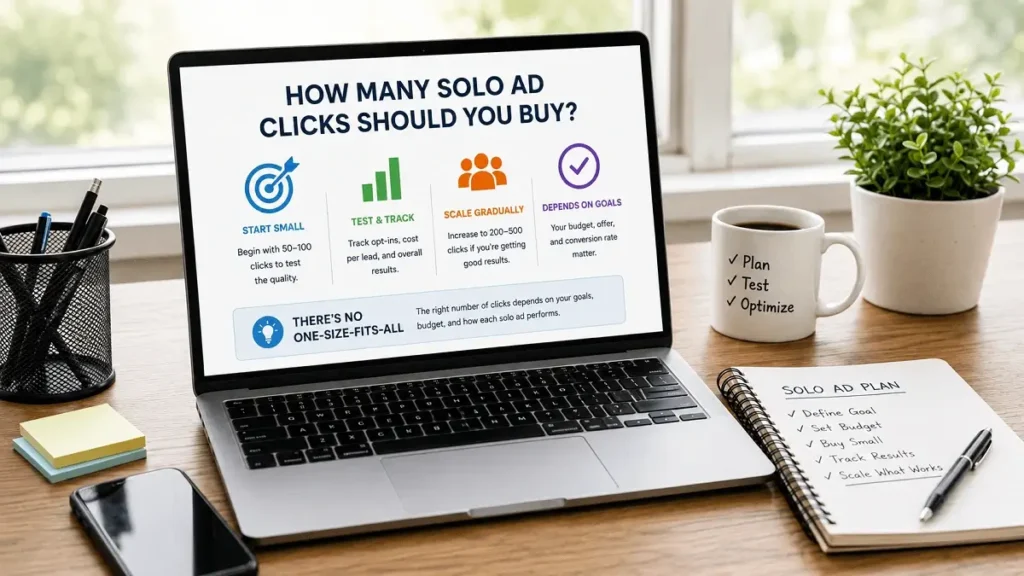
For a first solo ad test, 100–300 clicks is a reasonable starting range for many campaigns.
That is usually enough traffic to see whether visitors are reaching your page, opting in, coming from the countries you expected, and showing at least some engagement afterward.
It is not enough to prove that a provider will always perform the same way.
And if your main goal is measuring sales rather than leads, you may need considerably more traffic before the numbers become useful.
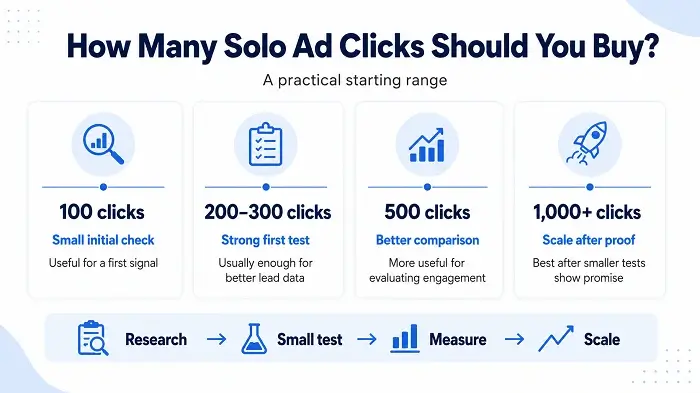
A simple starting point
100 clicks: very small initial check
200–300 clicks: more useful first test
500 clicks: better for comparing performance
1,000+ clicks: usually something I would consider after smaller tests
The right number depends on what you want to learn, how much a click costs, and how well your landing page converts.
Quick Answer
For a first solo ad test, 100–300 clicks is usually enough to learn something useful without committing too much budget.
I would only move to 500 or more clicks after the smaller test shows that the traffic, opt-in rate and follow-up results are worth scaling.
- Start With What You're Trying to Measure
- What Can 100 Clicks Tell You?
- Why I Like 200–300 Clicks for a First Proper Test
- What About 300 Clicks?
- When 500 Clicks Starts to Make More Sense
- How Much Could Those Tests Cost?
- How Many Leads Could You Expect?
- A 50-Click Test Can Be Too Small
- More Clicks Do Not Fix a Bad Funnel
- Don't Buy 1,000 Clicks Just for a Discount
- When 1,000+ Clicks Can Make Sense
- Scaling Should Be Gradual
- Your Opt-In Rate Changes How Much Data You Get
- Sales Require More Patience Than Opt-Ins
- Compare Providers With Similar Test Sizes
- Don't Stop a Test Too Early
- But Don't Keep Buying More Just to “Get More Data”
- A Simple First-Test Framework
- So How Many Solo Ad Clicks Should You Buy?
- Frequently Asked Questions
Start With What You’re Trying to Measure
The right number depends on what you are trying to measure. If you only want to check delivery, geography and whether the page converts at all, you probably do not need 1,000 clicks. If you want to judge sales consistently, you may need considerably more data because sales happen less often than opt-ins.
So instead of looking for one perfect number, I would start with a simpler question:
What am I trying to learn from this order?
That usually tells you whether a small check is enough or whether you need a larger sample.
What Can 100 Clicks Tell You?
A 100-click order is a relatively small test. If your landing page converts at 30%, that would give you about 30 leads.
100 clicks × 30% = about 30 leads
That is enough to start checking a few basic things:
- whether the traffic arrived
- which countries visitors came from
- whether your landing page converted at all
- whether the provider’s numbers are reasonably close to yours
- whether subscribers engage with your first follow-up emails
The limitation is that 100 clicks can still produce noisy results. A few extra opt-ins can move the conversion rate a lot, which is why I would treat a test this small as an initial signal rather than a final verdict.
For example:
25 leads from 100 clicks = 25% opt-in rate
35 leads from 100 clicks = 35% opt-in rate
That is a large-looking difference caused by only ten people, which is exactly why I would be careful about making a big decision from one 100-click test.
Why I Like 200–300 Clicks for a First Proper Test
Once you get into roughly 200–300 clicks, you have more information to work with without necessarily putting a large amount of money at risk.
With 200 clicks, the number of subscribers you have to evaluate depends heavily on the landing-page conversion rate:
| Opt-in rate | Clicks | Approx. leads |
|---|---|---|
| 20% | 200 | 40 |
| 30% | 200 | 60 |
| 40% | 200 | 80 |
At that point you can start looking beyond the opt-in rate: whether subscribers open and click follow-up emails, how quickly they unsubscribe, and whether any of them convert. Those signals matter because the value of a campaign is not determined by the click count alone.
That is the same reason I would judge the result in context rather than by click count alone, as explained in Are Solo Ads Worth It?.
What About 300 Clicks?
Three hundred clicks gives you a little more room. At a 30% opt-in rate that is about 90 leads; at 40%, about 120. The larger sample makes differences between campaigns easier to see without turning the first order into a huge commitment.
If the budget allows it, I think 300 clicks is a comfortable size for testing a provider you have researched but have never used before: still controlled, but large enough to evaluate more than the first few visitors.
When 500 Clicks Starts to Make More Sense
A 500-click order becomes more useful once you are reasonably confident in the provider and want a cleaner comparison between campaigns. For example, two sellers might each send 500 clicks but produce very different lead numbers.
| Provider | Clicks | Leads | Opt-in rate |
|---|---|---|---|
| A | 500 | 125 | 25% |
| B | 500 | 180 | 36% |
That kind of difference is much more informative than comparing two tiny 50-click campaigns.
You also have more leads available for checking:
- follow-up engagement
- unsubscribes
- conversions
- longer-term lead value
But I would not automatically start with 500 clicks just because it produces better data.
The extra information has to be worth the extra cost.
How Much Could Those Tests Cost?
Your click price changes the decision.
Suppose traffic costs $0.60 per click.
100 clicks: $60
200 clicks: $120
300 clicks: $180
500 clicks: $300
1,000 clicks: $600
At $0.90 per click:
100 clicks: $90
200 clicks: $180
300 clicks: $270
500 clicks: $450
1,000 clicks: $900
This is why there is no universal recommendation such as “everyone should buy 500 clicks.”
A sensible test size has to fit your budget too.
As discussed in How Much Do Solo Ads Cost?, I would rather run a smaller test comfortably than overspend simply to reach an arbitrary click count.
If you want to compare different order sizes before buying, use the Solo Ad Campaign Calculator to estimate your campaign cost, clicks and possible results.
How Many Leads Could You Expect?
The same click order can produce very different numbers of leads depending on how well your landing page converts.
Here is a simple example:
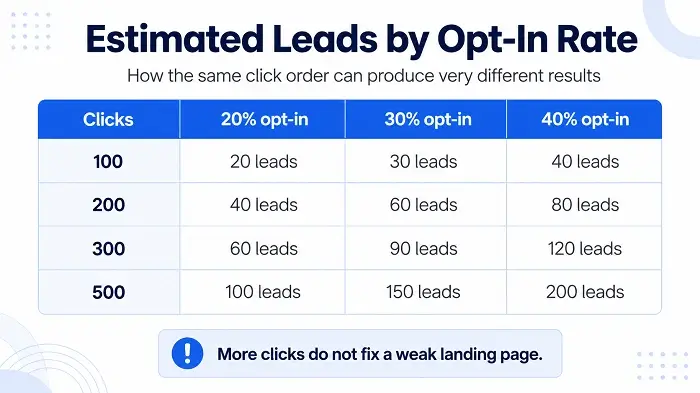
These are examples, not expected results.
Your actual conversion rate depends on the traffic, page, offer, device mix and audience fit.
But this kind of table helps explain why the same number of clicks can be much more useful for one funnel than another.
A 50-Click Test Can Be Too Small
There is nothing wrong with buying 50 clicks if that is all you want to risk, but I would be careful about drawing big conclusions from such a small sample.
For example, if your first 50 clicks produce 10 leads, that is a 20% opt-in rate. If the next 50 produce 18 leads, the rate jumps to 36%.
That does not necessarily mean the traffic quality suddenly improved. With a small sample, normal variation can move the percentage a lot, so I would not call a provider excellent or terrible based entirely on a 50-click result.
More Clicks Do Not Fix a Bad Funnel
This is one of the easiest mistakes to make.
Imagine you buy 200 clicks and only get 12 subscribers.
You might think:
“Maybe I need 1,000 clicks to get better data.”
But first I would look at the landing page.
If the page is confusing, slow, poorly matched to the traffic or simply not convincing, sending five times more visitors may just produce five times more wasted traffic.
More traffic does not repair:
- a weak headline
- an irrelevant lead magnet
- broken forms
- slow page loading
- poor mobile layout
- an offer that does not match the audience
Before increasing the order, make sure the funnel itself deserves more traffic.
Don’t Buy 1,000 Clicks Just for a Discount
Providers sometimes charge less per click when you buy larger packages.
For example:
200 clicks at $0.70 = $140
500 clicks at $0.60 = $300
1,000 clicks at $0.50 = $500
The 1,000-click package has the best CPC, but it also means spending $360 more than the 200-click test. If I had never used the provider before, saving $0.20 per click would not be enough reason to put several hundred extra dollars at risk.
I would rather discover poor traffic after 200 clicks than after 1,000.
When 1,000+ Clicks Can Make Sense
Larger orders become more interesting after you have evidence that the traffic works with your funnel.
For example, imagine you have already run:
Test 1
200 clicks
acceptable CPL
decent follow-up engagement
Then:
Test 2
300 clicks
similar CPL
similar subscriber behavior
some conversions
At that point, a larger test has a reason behind it. You are not buying 1,000 clicks simply because you hope they will work; you are increasing the order because smaller campaigns gave you evidence that scaling may make sense.
Scaling Should Be Gradual
I would not necessarily jump from 200 clicks straight to 5,000.
A more controlled progression might be 200 clicks to check the basics, 300–500 to see whether the result remains reasonably consistent, and 500–1,000 when you want more confidence in engagement and conversions. Larger orders make more sense only after the economics continue to hold up.
The principle is simple: increase your exposure as your confidence increases.
Those are not mandatory thresholds. They are just a practical way to avoid making the largest commitment before you have learned anything about the provider.
Your Opt-In Rate Changes How Much Data You Get
Suppose two landing pages each receive 200 clicks. Page A converts at 15% and produces 30 leads, while Page B converts at 45% and produces 90. The traffic volume is identical, but Page B gives you three times as many subscribers to evaluate afterward.
That means the number of clicks needed for useful analysis depends partly on how efficiently your funnel turns visitors into leads. If the conversion rate is very low, you may need more traffic to collect enough lead-level data — but I would first ask whether the page should be fixed before buying more clicks.
Sales Require More Patience Than Opt-Ins
This is another reason not to use one click recommendation for every goal.
Suppose:
200 clicks
60 leads
2 sales
If your next test generates one sale instead of two, does that mean the provider became 50% worse?
Probably not enough information to say.
Sales happen less frequently than clicks or opt-ins, so small campaigns can make sales conversion rates jump around considerably.
That is why I am more comfortable using a smaller test to evaluate:
- delivery
- geography
- opt-in behavior
- basic engagement
than using the same small test to make strong claims about long-term sales performance.
Compare Providers With Similar Test Sizes
If you are comparing sellers, try to make the comparison reasonably fair.
For example:
Provider A: 100 clicks
Provider B: 1,000 clicks
That comparison is harder to interpret.
A better setup might be:
Provider A: 250 clicks
Provider B: 250 clicks
using the same:
- landing page
- offer
- tracking setup
- email sequence
- targeting where possible
You will never remove every variable, but keeping the campaigns reasonably similar makes the numbers much more useful.
This also connects with How to Choose a Solo Ad Provider: the goal is not just finding a seller, but creating a test that lets you judge that seller fairly.
Don’t Stop a Test Too Early
Another mistake is watching every few clicks.
Suppose you order 300 clicks.
After the first 30 clicks, your page has only converted four visitors.
It can be tempting to decide the campaign is terrible immediately.
But a tiny early sample can move around considerably.
Unless there is an obvious problem — broken page, completely wrong geography, suspicious traffic, tracking failure — I would normally let enough of the agreed traffic arrive before making a final judgment.
Otherwise you may be reacting to noise rather than a real pattern.
But Don’t Keep Buying More Just to “Get More Data”
There is a point where testing becomes an excuse. Suppose you have already purchased:
200 clicks
then another 300
then another 500
and the same problems keep appearing:
- poor lead quality
- almost no follow-up engagement
- bad geography
- weak conversion
- questionable traffic patterns
You probably do not need another 2,000 clicks to confirm what the first 1,000 were telling you.
Testing should reduce uncertainty.
It should not become a reason to keep spending on something that repeatedly fails.
A Simple First-Test Framework
If I were choosing a new solo ad provider today, I would use a simple five-step process:
- Research the provider. Check the traffic source, geography, pricing and recent feedback.
- Choose a manageable order. For a first test, that is often around 100–300 clicks depending on price and budget.
- Track it separately. Know which visitors and leads came from this specific campaign.
- Watch more than opt-ins. Check CPL, geography, follow-up engagement and conversions.
- Decide from the data. Stop, retest or gradually increase the order based on what the campaign actually produced.
For a deeper look at Step 3, see How to Track Solo Ads.
That is much more useful than deciding in advance that every provider deserves exactly 500 clicks.
So How Many Solo Ad Clicks Should You Buy?
For a new provider, I would generally be more comfortable starting somewhere around 100–300 clicks.
A very small 50–100-click order can provide an initial signal, while 200–300 clicks usually gives you more useful information without immediately committing to a large campaign.
Once a provider has shown promising results, 300–500 clicks or more can help you see whether those results hold up with additional traffic.
I would reserve 1,000+ click orders for situations where I already have a reason to believe the provider and funnel work together.
The important part is not finding a magical click number.
It is increasing the size of the test as the evidence improves.
Research → Small test → Measure → Retest → Scale
And before buying any larger package, make sure you understand exactly what kind of traffic you are ordering.
That brings us to the next guide:
What Is Tier 1 Solo Ad Traffic?