

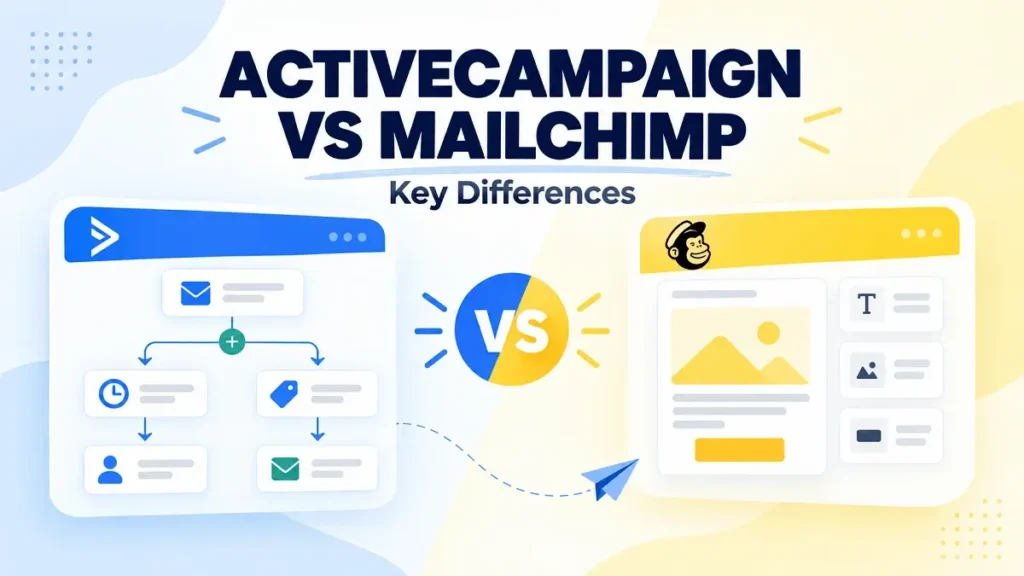
ActiveCampaign and Mailchimp both handle email marketing, but they approach the job differently. Mailchimp is easier to recognize as a general email marketing platform with campaigns, templates, reporting and growing automation features. ActiveCampaign is more automation-first, with deeper segmentation and customer journeys at the center of the product.
Quick Answer
Mailchimp is usually easier for straightforward newsletters and simpler campaigns. ActiveCampaign makes more sense when automation, segmentation and multi-step customer journeys are the main reason you are paying for email software.
Both scale pricing with contact count, so the cheaper option can change as your list grows.
ActiveCampaign vs Mailchimp at a Glance
| ActiveCampaign | Mailchimp | |
|---|---|---|
| Main strength | Automation and segmentation | Email campaigns and broad SMB marketing |
| Free plan | No permanent free tier in the main paid lineup | Yes, up to 250 contacts |
| Entry paid structure | Starter, then Plus / Pro / Enterprise | Essentials, Standard, Premium |
| Pricing scales with contacts | Yes | Yes |
| Automation depth | Core product strength | Strongest on higher plans |
| CRM orientation | More integrated into customer journeys | More email-marketing centered |
The Main Difference Is Automation Depth
ActiveCampaign is built around the idea that contacts move through different journeys depending on what they do. That makes conditions, branching, segmentation and automation actions central to the product.
Its Starter plan includes automation, but limits each automation to five actions. Plus removes that tight limit, while Pro adds more advanced segmentation, predictive and attribution capabilities.
Mailchimp also supports automation, but its product is easier to approach if your workflow starts with campaigns, newsletters and audience management rather than complex behavioral journeys.
Pricing Works Differently Than the Headline Number Suggests
Both platforms charge according to list size, so comparing one entry price is not enough.
ActiveCampaign’s official examples show prices increasing significantly between 1,000 and 5,000 contacts. Mailchimp also asks you to choose a contact tier, and that tier determines both your contact allowance and monthly sending limit.
Mailchimp currently offers Free, Essentials, Standard and Premium. The Free plan is limited to 250 contacts. Essentials currently starts around $13/month and Standard around $20/month at the entry tier, while Premium is positioned much higher.
For ActiveCampaign’s current contact-based examples, see our ActiveCampaign Pricing guide.
Mailchimp Is Easier to Start With
For someone sending a monthly newsletter, occasional promotions and a basic welcome series, Mailchimp is easier to understand.
The interface and plan structure are built around common small-business email tasks. The free tier also gives you a way to learn the product before paying, even though the 250-contact limit is now fairly small.
That simplicity is useful if you do not want to spend time designing complicated automations.
ActiveCampaign Is Better Suited to Complex Journeys
Imagine a contact downloads a guide, visits a pricing page, clicks one product category, ignores two emails and then makes a purchase.
If you want each of those actions to change what happens next, ActiveCampaign’s automation-first model becomes more useful. You can build sequences around behavior rather than just sending the same campaign to one list segment.
This is where ActiveCampaign tends to justify the extra setup effort.
What About Sending Limits?
Mailchimp ties monthly send allowances to your chosen contact tier. Its Standard plan currently uses a send allowance equal to 12 times the maximum contact count.
ActiveCampaign also ties email volume to plan/contact allowances rather than advertising one universal unlimited number.
If you email your entire list several times per week, check this carefully. Two platforms with the same contact price can still have very different effective costs once send limits are included.
Which Is Better for Ecommerce?
Both integrate with ecommerce platforms and support purchase-based segmentation and automation.
Mailchimp is easier if your needs are product recommendations, campaigns and basic ecommerce follow-up. ActiveCampaign becomes more compelling when the customer lifecycle is more complicated and you want purchase behavior to trigger longer multi-step journeys.
The decision is less about whether either platform supports ecommerce and more about how much automation logic you want around it.
A Simple Example
Suppose you have 5,000 contacts and send one newsletter per week plus a welcome automation.
That is a fairly simple workload. Mailchimp can handle it without requiring a complicated automation architecture.
Now imagine the same 5,000 contacts are split by lead source, product interest, purchase history and engagement score, with different follow-up after every meaningful action. That is the type of setup where ActiveCampaign’s extra automation depth becomes more valuable.
Which Is Easier for a Beginner?
Mailchimp is generally the easier starting point because you can get to a normal email campaign quickly.
ActiveCampaign is not inherently difficult, but it gives you many more decisions once you start building automations. That flexibility only helps if you actually need it.
When Mailchimp Makes More Sense
- You mainly send newsletters and promotional campaigns.
- You want a recognizable, straightforward email platform.
- You want a small free tier to test the workflow.
- You do not need complex branching automations.
When ActiveCampaign Makes More Sense
- Automation is central to your marketing.
- You need deeper segmentation and behavioral triggers.
- You want customer journeys to change based on actions.
- You are willing to spend more time setting up the system correctly.
ActiveCampaign vs Mailchimp: Practical Takeaway
Mailchimp is the easier email-first choice. ActiveCampaign is the stronger automation-first choice.
I would not choose ActiveCampaign simply because it has more automation features, and I would not choose Mailchimp simply because the entry plan is cheaper. Start with the complexity of the customer journey you actually need to run.
For more email platform comparisons, see our Software & Marketing Tools hub.