

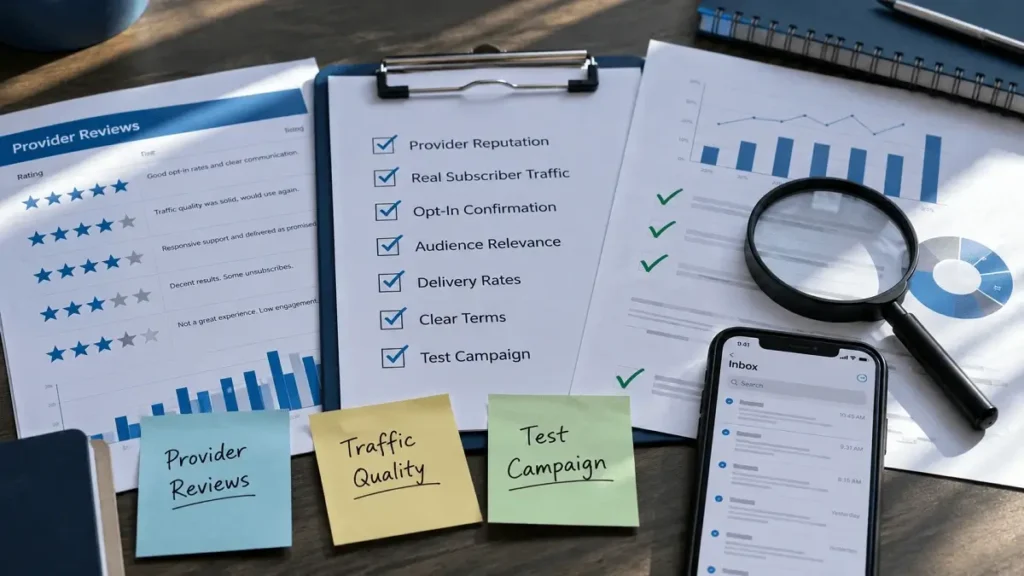
Solo ads are a legitimate way to buy email traffic, but that does not mean every seller is trustworthy or every click will be useful.
The useful question is not whether solo ads as a whole are “real.” It is whether a particular provider sends the kind of traffic they promised, from the audience and countries you expected, without suspicious patterns.
Quick Answer
Yes, solo ads are a legitimate form of paid email traffic. You pay a provider with an existing email audience to send visitors to your landing page.
What varies is the seller, the audience and the traffic quality. Real clicks can still be a poor fit, so I would judge providers one at a time and start with a small test.
- So, Are Solo Ads Legit?
- Real Traffic Can Still Be Bad Traffic
- Why Do Some People Call Solo Ads a Scam?
- Solo Ad Red Flags to Watch For
- What Should You Ask a Solo Ad Seller?
- Can You Trust Solo Ad Reviews?
- Are Solo Ad Marketplaces Safer?
- How Can You Tell If the Traffic Looks Suspicious?
- Start Small With a New Seller
- When I Would Walk Away
- Legit Does Not Mean Profitable
- Are Solo Ads Legit? The Simple Answer
- Frequently Asked Questions
So, Are Solo Ads Legit?
Yes. The basic model is simple: a provider sends an email to their own audience, people click the link, and those visitors arrive on your page. You are buying traffic, not buying the provider’s email list.
The word legit causes confusion because people often use it to mean several different things at once. Were the clicks real? Did they come from the countries promised? Was the audience relevant? Did the campaign produce useful leads? Those are different questions.
A provider can deliver 300 real visitors and still give you a disappointing campaign. That does not automatically make the traffic fake. If you are new to the model, start with What Are Solo Ads?.
Real Traffic Can Still Be Bad Traffic
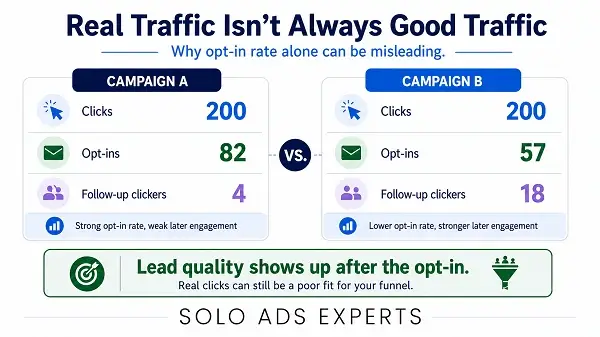
This is the distinction I would keep in mind throughout the whole campaign. Traffic can be real and still be weak, overused or simply wrong for your offer.
- Real and relevant: visitors fit the offer and continue engaging after the opt-in.
- Real but poorly matched: visitors are genuine, but the offer is not a good fit.
- Weak or overused: subscribers have seen so many similar promotions that they barely respond.
- Suspicious: patterns suggest automation, duplicates or traffic that does not match what was ordered.
That is why I would not judge legitimacy from opt-in rate alone. One provider might produce lots of signups that never click again, while another produces fewer leads that keep engaging with your emails.
Why Do Some People Call Solo Ads a Scam?
Usually because they paid for traffic and the campaign performed badly. Sometimes the seller really is the problem, but sometimes the issue is the page, the offer or the audience fit.
A weak campaign can happen because the landing page converts poorly, the list is over-promoted, the provider’s email creates the wrong expectation or the visitors simply are not interested. None of those things proves the clicks were fake.
At the same time, suspicious traffic does exist. The useful approach is not to trust every seller or distrust the whole industry. It is to know what warning signs to look for.
Solo Ad Red Flags to Watch For
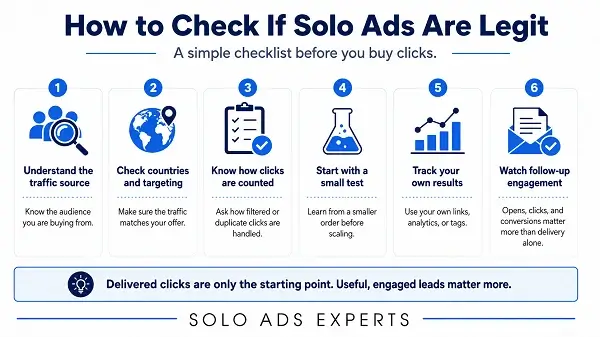
Guaranteed sales or profit
A traffic seller can control how they deliver visitors. They cannot control your landing page, pricing, email sequence or sales process. Claims such as “guaranteed buyers” or “guaranteed profit from 500 clicks” should make you cautious.
Very little information about the traffic
You do not need access to the seller’s database, but you should understand the basics: what kind of audience it is, which countries are available, how clicks are counted and how delivery works. “Premium traffic” is not much of an explanation by itself.
Pressure to make a large first order
There is usually no reason your first purchase needs to be your biggest one. A smaller test gives you a chance to see how the traffic behaves before risking more money.
Unrealistically cheap clicks combined with big promises
Cheap traffic is not automatically bad. The problem is the combination of extremely low pricing and claims that sound too good to be true. Price alone does not prove quality, but it should still make sense.
Everything looks perfect
Real traffic produces mixed results. If every testimonial is amazing, every screenshot shows huge wins and nobody appears to have had an average campaign, I would look for independent feedback before ordering.
What Should You Ask a Solo Ad Seller?
You do not need to interrogate a provider before buying 100 or 200 clicks. A few direct questions are enough:
- Where does the traffic generally come from?
- Which countries can I target?
- How are valid clicks counted?
- Are duplicate or suspicious clicks filtered?
- How long does delivery normally take?
- What happens if the wrong traffic is delivered?
- Can I start with a smaller order?
Clear answers do not guarantee a great campaign, but vague or evasive answers tell you something too. For a fuller checklist, see How to Choose a Solo Ad Provider.
Can You Trust Solo Ad Reviews?
Reviews can help, but I would look for patterns rather than treating one positive review as proof. A reviewer may have a different offer, funnel, audience or budget. They may also be an affiliate, which does not automatically make the review dishonest, but it is still useful context.
What matters more is whether unrelated buyers keep mentioning the same strength or the same problem. Repeated patterns are more useful than one impressive screenshot.
Are Solo Ad Marketplaces Safer?
Marketplaces can reduce some uncertainty because they may show seller profiles, buyer feedback, order history, traffic filters and dispute handling. That can make comparison easier than buying from a seller you know nothing about.
It still does not make every provider equally good. You need to evaluate the individual seller. Udimi is one of the best-known examples, and we cover it separately in our Udimi review.
How Can You Tell If the Traffic Looks Suspicious?
You usually cannot prove traffic quality from one metric. I would look for a combination of signals rather than a single anomaly.
- traffic from countries you did not order
- unusual bursts that do not resemble normal delivery
- large numbers of visits with almost no normal user activity
- obvious duplicate or automated-looking behavior
- a large gap between what was promised and what your own tracking shows
A small mismatch does not prove fraud. Look for repeated patterns and compare the provider’s numbers with your own analytics. For that setup, see How to Track Solo Ads.
Start Small With a New Seller
You do not need a huge order to learn whether a provider deserves another test. If clicks cost $0.75, a 200-click test costs $150 while 1,000 clicks cost $750. The smaller test will not tell you everything, but it gives you real data before you commit five times as much money.
If you are unsure how large that first test should be, see How Many Solo Ad Clicks Should You Buy?.
When I Would Walk Away
I would probably choose another seller if they avoid basic questions, guarantee profit, push hard for a large first order or have repeated complaints about the same serious delivery problem.
There are enough providers available that you do not need to force an order that already feels questionable before it has even started.
Legit Does Not Mean Profitable
A seller can deliver real visitors, from the right countries, in the agreed quantity and still give you a campaign that loses money. That does not make the provider a scam. It means the traffic was not valuable enough for what you paid.
Whether the economics make sense is a separate question. We cover that in Are Solo Ads Worth It?.
Are Solo Ads Legit? The Simple Answer
Yes. Solo ads are a legitimate paid traffic method, but seller quality varies. I would judge one provider at a time: check the seller, start small, track the traffic and decide whether the results justify another order.