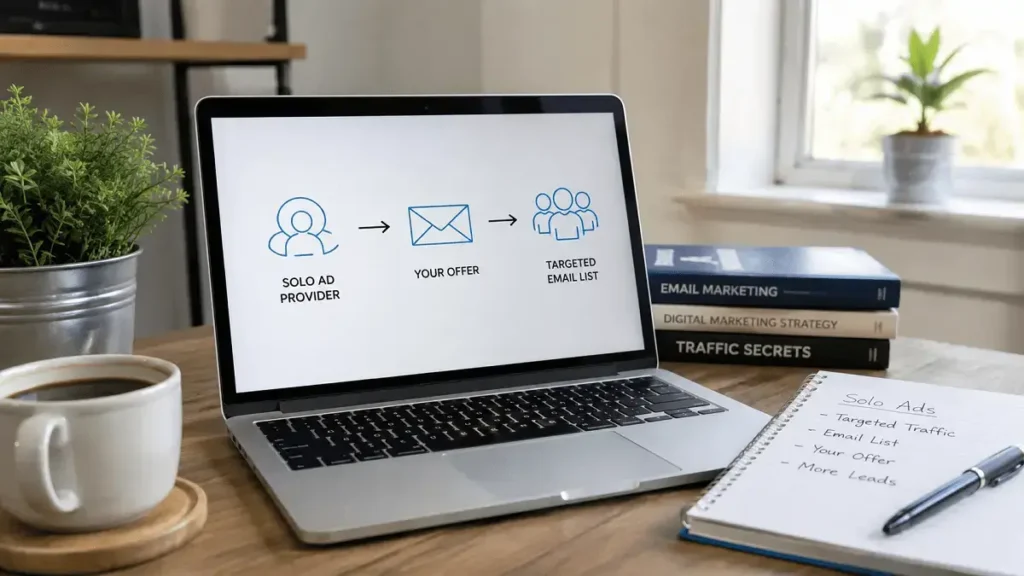
Choosing a solo ad provider is not really about finding the person with the cheapest clicks.
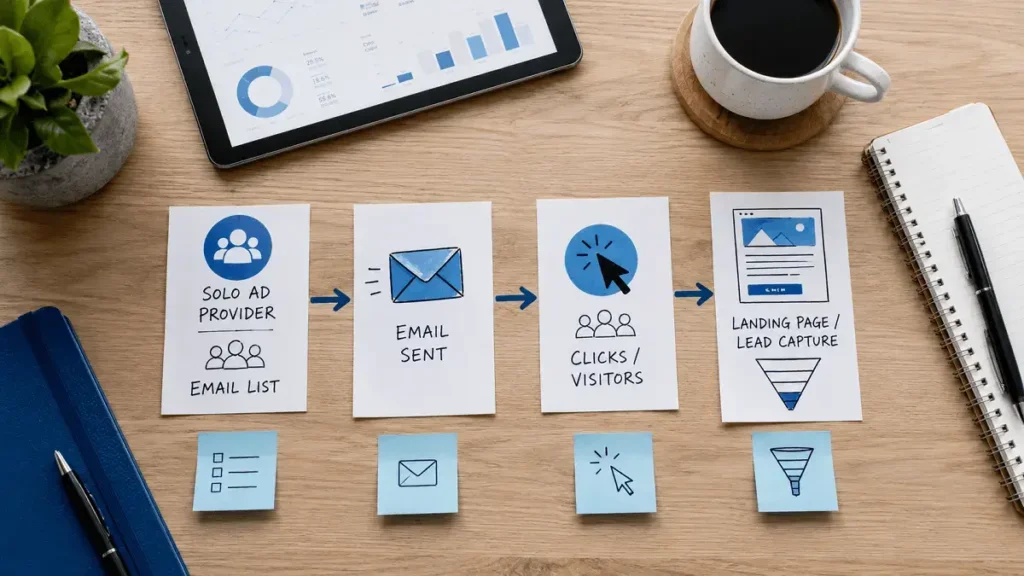
You are trying to find someone who can send real, relevant email traffic to your page and give you enough information to judge whether that traffic is worth buying again.
A provider can deliver every click you ordered and still be a poor choice if the audience does not fit your offer.
Quick answer
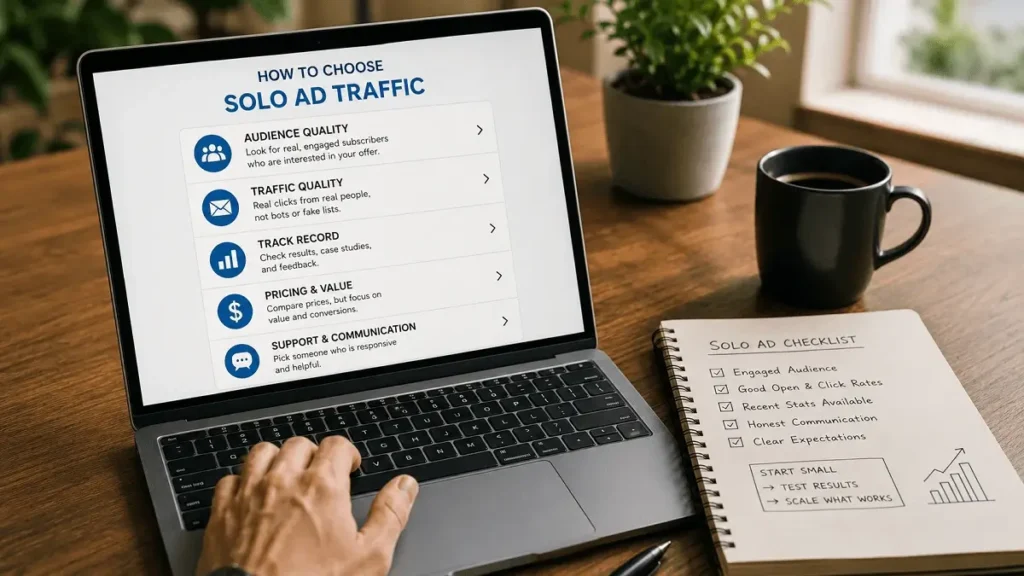
Before buying, I would check the traffic source, countries, pricing, minimum order, tracking, refund or replacement policy, recent feedback, and whether the provider is willing to answer basic questions.
Then I would start with a relatively small test and judge the traffic using my own tracking.
- Start With Your Own Offer
- Ask Where the Traffic Comes From
- Check Which Countries You Are Buying
- Don't Choose by Cost per Click Alone
- Look at the Minimum Order
- Ask How Clicks Are Counted
- Use Your Own Tracking
- Look Beyond Testimonials
- Recent Feedback Matters More Than Ancient Feedback
- Look at How the Provider Responds to Questions
- Be Careful With Guaranteed Sales
- Ask About Replacement or Refund Policies
- Look for Clear Pricing
- A Cheap Price Can Hide an Expensive Campaign
- Watch What Happens After the Opt-In
- Start With a Small Test
- Don't Change Everything During the Test
- How I Would Compare Providers
- Questions I Would Ask Before Ordering
- Red Flags I Would Watch For
- Marketplace or Direct Provider?
- Create a Simple Provider Scorecard
- Keep Records of Every Test
- How I Would Make the Final Decision
Start With Your Own Offer
Before comparing providers, decide what kind of visitor you actually want.
For example, traffic that may work for:
- an affiliate marketing offer
- a business opportunity funnel
- an email marketing guide
- a make-money-online lead magnet
may not work nearly as well for:
- a local plumbing company
- a physical product store
- a highly specialized B2B service
Solo ad traffic is commonly associated with online marketing, business opportunities, affiliate marketing and related audiences.
That means the first question should not be:
Who has the best price?
It should be:
Does this provider’s audience make sense for what I’m promoting?
Ask Where the Traffic Comes From
I would want at least a basic explanation of the traffic source.
A provider does not need to reveal every detail about their list or business.
But answers like these are useful:
“I send your offer to subscribers on my own email lists.”
or:
“Traffic comes from several email lists we manage in the online business niche.”
An answer like:
“Don’t worry, it’s premium traffic.”
does not tell you much.
If the provider is unwilling to explain even broadly where the clicks originate, I would be cautious.
Check Which Countries You Are Buying
Geography matters.
If your offer is aimed at people in the United States, getting most of your traffic from countries you did not expect can make the results difficult to interpret.
Ask whether the order includes:
- United States
- Canada
- United Kingdom
- Australia
- other countries
- worldwide traffic
You may also see the term Tier 1 traffic, which generally refers to visitors from higher-value English-speaking markets such as the US, UK, Canada, Australia and similar countries.
We will cover that separately in the guide What Is Tier 1 Solo Ad Traffic?
For now, the important part is simple:
Know what geography you are paying for before the campaign starts.
Don’t Choose by Cost per Click Alone
Suppose you are comparing two providers.
Provider A
Price: $0.40 per click
250 clicks: $100
Provider B
Price: $0.70 per click
250 clicks: $175
Provider A looks much cheaper.
But after the campaigns:
Provider A
250 clicks
25 leads
CPL: $4
Provider B
250 clicks
88 leads
CPL: about $1.99
The more expensive clicks produced cheaper leads.
This is why price per click is only the first number.
As we covered in How Much Do Solo Ads Cost?, what matters more is what happens after those clicks arrive.
Look at the Minimum Order
Minimum order size tells you how much money you have to risk before you learn anything about the provider.
If one seller allows a 100-click test while another requires 1,000 clicks, that matters.
I generally prefer being able to start smaller with someone I have never used before.
You can always scale later.
You cannot undo a large poor-quality order after it has already been delivered.
Ask How Clicks Are Counted
Different tracking systems can report slightly different numbers.
That is normal to a point.
But I would still want to understand what the provider counts as a valid click.
Questions worth asking include:
- Are duplicate clicks filtered?
- Are obvious bots filtered?
- Are repeated clicks from the same visitor counted?
- How is geography checked?
- Is over-delivery included?
- What happens if the order under-delivers?
You do not need a technical interrogation.
You just want enough information to understand what you are buying.
Use Your Own Tracking
I would not rely only on the provider’s dashboard.
Use your own tracking as well.
At minimum, try to identify:
- clicks
- visitors
- opt-ins
- cost per lead
- countries
- follow-up email activity
- conversions
That lets you compare what the provider reports with what your own systems see.
Small differences do not automatically mean something is wrong.
Tracking platforms can count visits differently.
Large unexplained differences are worth investigating.
Look Beyond Testimonials
Testimonials can be useful, but I would not treat them as proof that your campaign will work.
A positive review might come from someone with:
- a different landing page
- a different offer
- a stronger email sequence
- a different audience
- a different campaign date
- a different order size
Some reviews may also be promotional or affiliate-driven.
I like to look for patterns rather than one glowing review.
If many different buyers mention similar strengths or problems, that is more interesting.
Recent Feedback Matters More Than Ancient Feedback
A provider may have built an excellent reputation years ago.
That does not necessarily tell you what their traffic looks like today.
Lists change.
Engagement changes.
Traffic sources change.
Business practices change.
So when researching a provider, I would pay particular attention to recent buyer experiences.
That does not mean ignoring older reviews.
It just means I would not let a five-year-old testimonial outweigh everything more recent.
Look at How the Provider Responds to Questions
This is an underrated part of choosing someone.
Send a basic question before ordering.
For example:
What countries are included in this traffic?
or:
Would this audience be suitable for an affiliate marketing lead magnet?
You are not only looking at the answer.
You are also seeing how the seller communicates.
Do they give a clear response?
Do they avoid the question?
Do they immediately push you toward the biggest package?
Do they promise unrealistic results?
Good communication does not guarantee good traffic.
But poor communication before you pay rarely becomes better afterward.
Be Careful With Guaranteed Sales
A provider can control how they send the traffic.
They cannot control your entire funnel.
They cannot control:
- your landing page
- your offer
- your pricing
- your email sequence
- whether visitors trust you
- whether someone eventually buys
That is why claims like:
“Guaranteed 10 sales”
or:
“You will make your money back”
would make me cautious.
Traffic can be guaranteed.
Specific business results are much harder to guarantee honestly.
Ask About Replacement or Refund Policies
You should know what happens if something goes wrong.
For example:
- What if the order does not fully deliver?
- What if the wrong countries are sent?
- Are invalid clicks replaced?
- Can an order be cancelled before delivery starts?
- Are refunds available under certain conditions?
Do not assume every provider handles these situations the same way.
Read the terms before paying.
Look for Clear Pricing
A provider should make it reasonably easy to understand what you are buying.
I would want to know:
Number of clicks
Price per click
Total order cost
Countries included
Any targeting options
Expected delivery period
If you cannot work out what the final order actually contains, that is a problem.
A Cheap Price Can Hide an Expensive Campaign
Imagine this:
Seller A
Order cost: $80
Leads generated: 12
CPL: $6.67
Seller B
Order cost: $160
Leads generated: 80
CPL: $2
Seller B costs twice as much upfront.
But the traffic produces leads at less than one-third of the cost.
This is why the phrase cheap solo ads can be misleading.
Cheap traffic is only useful if the visitors do something useful.
Watch What Happens After the Opt-In
I keep coming back to this because it is easy to overlook.
A provider could deliver:
200 clicks
90 opt-ins
45% opt-in rate
That looks excellent.
But then:
3 people click a follow-up email
almost nobody opens after the first few days
no meaningful conversions occur
Compare that with:
200 clicks
60 opt-ins
30% opt-in rate
19 follow-up clickers
several conversions
The second campaign may be much more valuable.
A strong opt-in rate does not automatically mean strong traffic.
Start With a Small Test
If I were trying a provider for the first time, I would generally prefer a smaller order.
Something like 100–300 clicks can often give you useful initial information without committing to a huge campaign.
The exact number depends on your budget and the provider’s minimum order.
Your first campaign is partly about results.
It is also about learning.
You are trying to answer:
- Did the traffic arrive correctly?
- Did the geography match?
- Did visitors opt in?
- Did subscribers engage afterward?
- Did tracking look normal?
- Was communication good?
Once you know those things, deciding whether to buy more becomes easier.
Don’t Change Everything During the Test
Suppose you buy traffic from Provider A.
Halfway through the campaign you change:
- the headline
- the landing page
- the lead magnet
- the email sequence
- the offer
Now it becomes harder to know what caused the results.
For a provider comparison, try to keep the important parts of your funnel reasonably consistent.
Otherwise you may accidentally blame the traffic for a landing-page problem or credit the provider for an improvement caused by something else.
How I Would Compare Providers
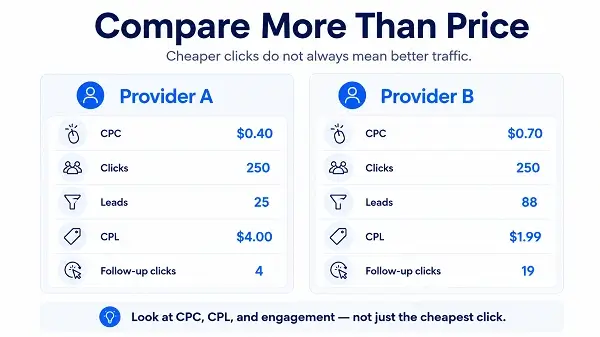
The cheaper provider is not automatically the better choice. I’d compare CPC, CPL, lead quality and what subscribers do after opting in.
At first glance, Provider A has the cheaper CPL.
But Provider B generated considerably more follow-up engagement and more sales.
That makes the decision less obvious.
This is the kind of comparison I find more useful than a simple star rating.
Questions I Would Ask Before Ordering
You do not need to send a provider a twenty-question interview.
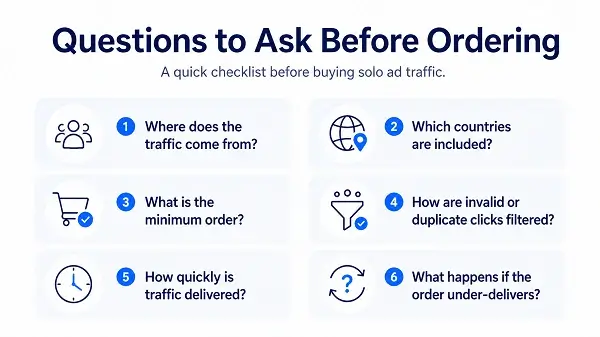
But these are useful things to know:
Where does your traffic come from?
Which countries are included?
What is the minimum order?
How do you filter duplicate or invalid clicks?
How quickly is traffic usually delivered?
Do you offer over-delivery?
What happens if the order under-delivers?
Would your audience be a reasonable fit for my type of offer?
A trustworthy provider should be able to answer basic questions without turning everything into a sales pitch.
Red Flags I Would Watch For
One red flag alone does not always prove that a provider is bad.
Several together would make me uncomfortable.
Things I would watch include:
- guaranteed income or sales
- no explanation of traffic source
- pressure to make a very large first purchase
- unclear pricing
- unrealistic claims
- no visible policies
- evasive answers about countries
- reviews that all sound suspiciously similar
- no way to contact the provider
- unwillingness to discuss obvious delivery problems
The goal is not to become paranoid.
It is simply to avoid sending money when too many basic questions remain unanswered.
Marketplace or Direct Provider?
You may find solo ads through a marketplace or buy directly from a provider.
Both approaches can work.
A marketplace may make it easier to compare sellers, reviews, pricing and order history.
Buying directly may sometimes offer different pricing or more flexibility.
Neither automatically guarantees better traffic.
For someone who is new to solo ads, a marketplace such as Udimi can be useful because many sellers can be compared in one place.
We will cover Udimi separately rather than turning this guide into a marketplace review.
Create a Simple Provider Scorecard
One thing that can make comparisons easier is scoring the same factors every time.
For example:
Traffic fit: 1–5
Communication: 1–5
Pricing clarity: 1–5
Tracking quality: 1–5
CPL: 1–5
Follow-up engagement: 1–5
Overall confidence: 1–5
The score itself is not scientific.
What matters is forcing yourself to evaluate providers consistently.
Later, this is something we can turn into a Solo Ad Provider Comparison Tool on Solo Ads Experts.
Keep Records of Every Test
Do not rely on memory.
Record:
- provider
- date
- clicks ordered
- cost
- countries
- clicks received
- opt-ins
- CPL
- follow-up engagement
- conversions
- anything unusual
Six months later, those records become much more valuable.
You may discover that one provider consistently produces cheaper clicks while another consistently produces better subscribers.
Without records, those patterns are easy to miss.
How I Would Make the Final Decision
Before buying from a new provider, I would want reasonable answers to three questions.
Does the audience appear relevant?
If not, nothing else matters much.
Can I measure the traffic properly?
If I cannot track the campaign, I will learn very little from it.
Can I afford to test without needing the campaign to succeed?
A first order should be a test, not a financial rescue plan.
If those three pieces are in place, I would rather run a modest campaign and collect real data than spend weeks trying to find a supposedly perfect provider.
There probably is no universally “best” solo ad seller.
A provider that performs well for one funnel may perform poorly for another.
That is why my preferred approach is:
Research → Small test → Track → Compare → Repeat or stop
The provider earns a larger order by producing useful traffic in the smaller one.
Next guide: How Many Solo Ad Clicks Should You Buy?