
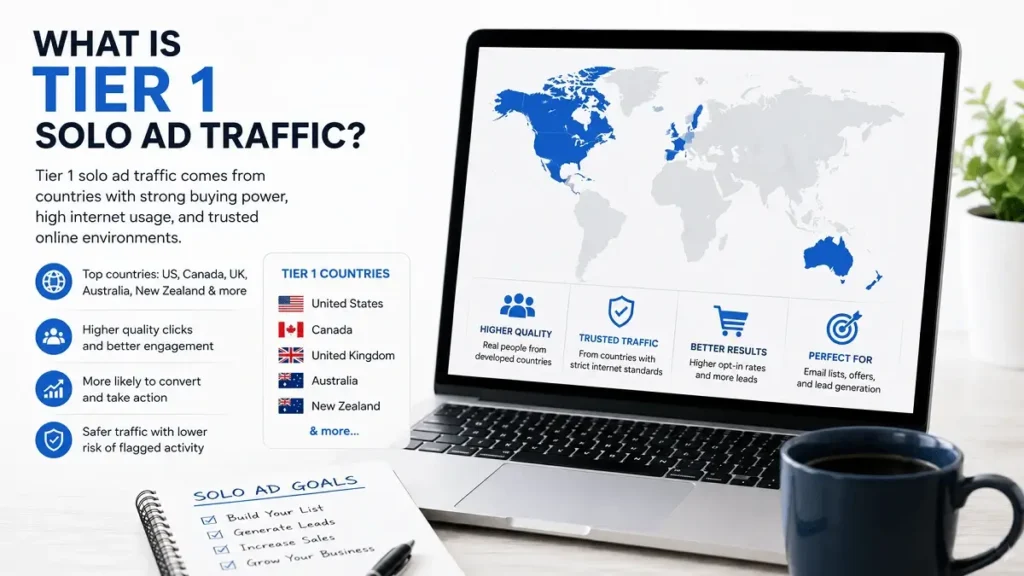
Tier 1 solo ad traffic generally means clicks from higher-value English-speaking countries such as the United States, United Kingdom, Canada and Australia.
Some providers also include countries such as New Zealand or others in their Tier 1 definition.
The important thing to know is that “Tier 1” is not a universal technical standard. Different sellers can use the term slightly differently.
So before paying extra for Tier 1 traffic, I would always check exactly which countries the provider includes.
Quick answer
Tier 1 solo ad traffic usually refers to visitors from countries such as the US, UK, Canada and Australia.
These clicks often cost more, but the label alone does not tell you whether the traffic will be engaged, relevant or profitable.
Which Countries Are Usually Considered Tier 1?
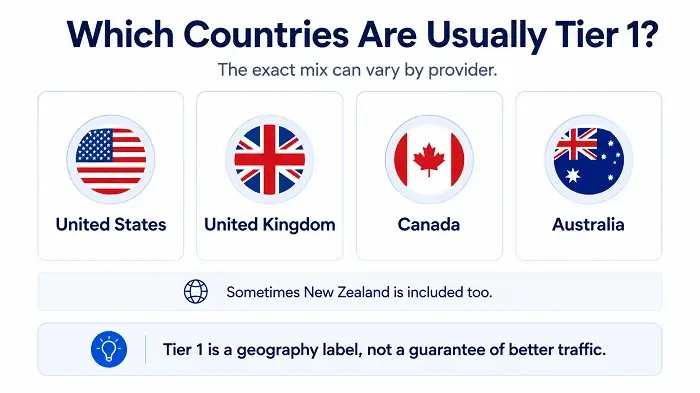
The countries I would most commonly expect to see are:
- United States
- United Kingdom
- Canada
- Australia
New Zealand is also sometimes included.
Some sellers may use a wider definition.
That is why I would not assume that two providers selling “Tier 1 traffic” are necessarily selling the same geographic mix.
For example:
Provider A
70% United States
15% Canada
10% United Kingdom
5% Australia
could be very different from:
Provider B
25% United States
25% United Kingdom
25% Canada
25% Australia
Both could reasonably advertise the order as Tier 1.
But depending on your offer, those campaigns might perform differently.
Why Is Tier 1 Traffic Usually More Expensive?
Advertisers generally place more value on traffic from countries where consumers have higher purchasing power and where many online offers are already designed to sell.
That can increase demand.
Solo ad providers may therefore charge more for traffic that is restricted to particular countries.
For example, imagine a seller offers:
Worldwide traffic: $0.40 per click
Tier 1 traffic: $0.70 per click
For 300 clicks:
Worldwide: 300 × $0.40 = $120
Tier 1: 300 × $0.70 = $210
You are spending another $90 for the geographic restriction.
Whether that extra cost is worth paying depends on your funnel.
Tier 1 Does Not Mean High-Quality Traffic
This distinction matters.
A visitor can be:
- located in the United States
- a real human
- counted correctly
and still have absolutely no interest in your offer.
Geography tells you where someone is located.
It does not automatically tell you:
- how interested they are
- how recently they joined the provider’s list
- how many offers they receive
- whether they normally buy things
- whether they will engage with your emails
- whether your offer matches them
So:
Tier 1 = geography
Tier 1 ≠ guaranteed quality
I would keep those two ideas separate.
A Tier 1 Click Can Still Be a Bad Click for Your Funnel
Imagine you buy 300 US-only clicks.
The traffic is legitimate.
Your tracking confirms that nearly all visitors came from the United States.
But the campaign produces:
300 clicks
30 opt-ins
10% opt-in rate
3 follow-up clickers
0 conversions
Now compare it with broader traffic:
300 clicks
90 opt-ins
30% opt-in rate
24 follow-up clickers
3 conversions
The second campaign may be much more useful even though it was not sold under a more impressive geographic label.
This is why I would never use “Tier 1” as the only measure of traffic quality.
When Tier 1 Traffic Makes More Sense
There are situations where paying for specific countries makes a lot of sense.
Your offer only accepts customers from certain countries
Some products, services or affiliate programs have geographic restrictions.
If customers outside those countries cannot buy, there is little reason to pay for those clicks.
Your landing page is written for a specific market
Currency, terminology and examples can make an offer much more relevant to one country than another.
A funnel discussing prices in US dollars and services available only in the United States may perform differently with visitors elsewhere.
You know which countries already convert
This is where tracking becomes useful.
Suppose previous campaigns show:
United States leads: $2.80 CPL
Canada leads: $3.10 CPL
Other countries: $6.40 CPL
Paying more to concentrate the next campaign on the stronger countries might make sense.
Now the decision is based on data rather than the Tier 1 label itself.
When I Wouldn’t Automatically Pay More for Tier 1
If I had no previous data and my offer could work internationally, I would not automatically assume that the most expensive geographic package was the best starting point.
I would want to know what the price difference actually buys me.
For example:
Campaign A — Tier 1
Cost: $240
Leads: 80
CPL: $3
Campaign B — broader traffic
Cost: $160
Leads: 80
CPL: $2
If the leads behave similarly afterward, Campaign B may be the better value.
But if Campaign A produces significantly stronger engagement and more conversions, the higher price may be justified.
The label itself doesn’t answer that.
The results do.
Ask for the Actual Country Breakdown
If a provider says they sell Tier 1 traffic, I would ask:
Which countries are included?
Then:
Can I choose individual countries?
And if geography is particularly important:
Can you provide mostly US traffic rather than a mixed Tier 1 order?
Those questions are more useful than simply asking whether the traffic is Tier 1.
This ties directly into How to Choose a Solo Ad Provider: clear information about geography should be part of evaluating the seller before ordering.
“US Traffic” and “Tier 1 Traffic” Aren’t Necessarily the Same Thing
This is easy to confuse.
If you order US-only traffic, you would normally expect the clicks to come specifically from the United States.
A Tier 1 order may contain traffic from several countries.
For example:
US-only order:
100% United States
versus:
Tier 1 order:
United States
Canada
United Kingdom
Australia
If the US market matters most to your funnel, buying generic Tier 1 traffic may not give you the geographic mix you actually want.
Check Geography With Your Own Tracking
If you paid specifically for certain countries, I would verify that independently.
Your tracking system or analytics platform can usually give you a geographic breakdown of visitors.
You might see something like:
United States: 68%
Canada: 14%
United Kingdom: 10%
Australia: 6%
Other: 2%
A small amount of unexpected traffic does not automatically prove anything is wrong.
Geolocation databases are not perfect, VPNs exist, and different systems can classify visitors differently.
But if you order US-only traffic and most of your own analytics shows visitors from completely different regions, I would ask the provider about it.
What About VPNs and Location Tracking?
IP-based location is useful, but it is not flawless.
Visitors can use:
- VPNs
- proxies
- mobile networks
- corporate networks
and IP databases themselves can sometimes be wrong.
That means I would not panic over a handful of mismatched visitors.
I would look for patterns.
For example:
Ordered: US traffic
Own tracking: 94% US
Probably not something I would worry much about.
But:
Ordered: US traffic
Own tracking: 38% US
That deserves a closer look.
Tier 1 Traffic Can Still Be Overused Traffic
Another issue has nothing to do with geography.
Imagine an email list consists entirely of people in the United States.
Technically, that could fit a US or Tier 1 targeting requirement.
But if those subscribers receive promotional offers constantly, they may be much less responsive.
That is why I would also care about:
- how the audience was built
- how frequently it receives offers
- whether the niche matches mine
- how subscribers behave after opting in
The country is only one part of the traffic profile.
Don’t Confuse Location With Buyer Intent
A common marketing shortcut is to think:
US visitor = buyer
It does not work that way.
A person living in New York who has zero interest in your offer is less valuable than a genuinely interested visitor elsewhere.
Buyer intent comes from things like:
- audience interest
- offer relevance
- timing
- trust
- funnel quality
Geography can help.
It cannot replace those things.
What Should Tier 1 Traffic Actually Improve?
If you are paying extra for it, I would want some reason for doing so.
Depending on the offer, that might mean:
- better lead quality
- stronger follow-up engagement
- more conversions
- higher customer value
- better compatibility with your affiliate offer
- fewer unusable leads from unsupported countries
If none of those things improves, paying more simply because the traffic carries a Tier 1 label does not accomplish much.
Compare Cost per Click With Cost per Lead
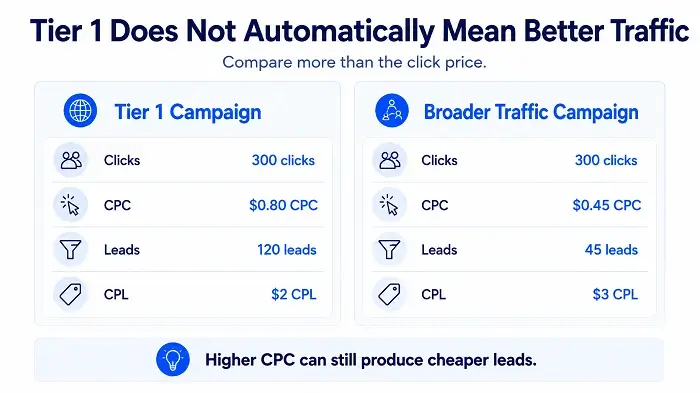
Suppose:
Tier 1 campaign
300 clicks
CPC: $0.80
Cost: $240
Leads: 120
CPL: $2
Now:
Worldwide campaign
300 clicks
CPC: $0.45
Cost: $135
Leads: 45
CPL: $3
The Tier 1 traffic costs almost twice as much per click.
But it produces the cheaper lead.
In that situation, paying more per click may actually save money.
Now reverse it:
Tier 1
$240 cost
60 leads
CPL: $4
Worldwide
$135 cost
90 leads
CPL: $1.50
Suddenly the cheaper traffic looks considerably better.
This is why the CPC alone doesn’t answer the question.
Then Check What Those Leads Do
Even CPL does not finish the comparison.
Suppose both campaigns produce leads for $2.
After two weeks:
Tier 1 leads
100 subscribers
28 follow-up clickers
Other traffic
100 subscribers
9 follow-up clickers
Now you have another useful clue.
This is the same principle we have been using throughout these guides:
Click → Lead → Engagement → Conversion
The further you follow the visitor through your funnel, the better you can judge what the traffic was actually worth.
Should Beginners Buy Tier 1 Traffic?
There is no rule saying beginners should or should not.
I would base the decision on the offer.
If your funnel is specifically designed around US, UK, Canadian or Australian visitors, restricting geography can be sensible even on the first test.
If your offer works internationally and you have no data yet, you may have more flexibility.
Either way, I would still start with a manageable test rather than buying a large order simply because the provider says the traffic is premium.
As discussed in How Many Solo Ad Clicks Should You Buy?, the size of your test should increase as your confidence increases.
A Better Way to Think About Tier 1
Instead of treating Tier 1 as a quality badge, I would treat it as one targeting option.
When comparing traffic, think about:
Country
Where does the visitor come from?
Audience
Is the visitor interested in your topic?
Price
What does the click cost?
Conversion
Does the visitor become a lead?
Engagement
Does the lead do anything afterward?
Value
Does the campaign eventually produce something worth paying for?
Tier 1 only answers the first question.
Before You Buy Tier 1 Solo Ads
I would check these things:
Which exact countries are included?
Can countries be selected individually?
Is the traffic truly email-based?
How much more does Tier 1 cost?
What is the minimum order?
Can I verify geography using my own tracking?
Does my offer actually benefit from those countries?
If you cannot explain why Tier 1 traffic is useful for your particular funnel, paying extra for it may simply be paying extra for a label.
Geographic targeting can be valuable.
But I would still judge the campaign the same way I judge any other solo ad traffic: by what the visitors and leads actually do.
And that leads naturally to the next part of our Guides section:
What Is a Good Solo Ad Opt-In Rate?